
The Tides of Démarche: Gold’s Metallic Rebellion Arrives

Gold and bitcoin prices are vaulting to new all-time highs and sticking a dagger beneath the ribs of the international monetary order. The precious/crypto rebellion against how money is supposed to work (according to the central bankers) is fueled by the drivers we presented in a note three months ago (Up, up, and away, 4-Dec-2023), in our long gold initiation note exactly one year ago (Gold likely works whether inflation slides, ranges, or surges, 15-Mar-2023), and in our one-on-one commodity meetings with institutional investors, especially over the past three months.
In no special order, these drivers are:
Driver #1: the fundamentals of cost to mine, process, refine, market, distribute, and securely store physical gold. All the gold ounces discovered in the history of human civilization could fit on one quarter of one international football field, according to the United States Geological Survey (specifically, “a cube that is 23 meters wide on every side”). That is an amazing reality for anyone who has visited the gold-laced Ashmolean Museum in Oxford or the gold-laden vaults beneath Threadneedle Street in London. One could be forgiven for assuming there must be so much more inventory elsewhere.
The relevant central fact in the current context is the spot gold price began clearing above the 90th percentile on the global gold production cost curve on Mar. 13, 2023 and above the 93rd percentile on Nov. 24, 2023, according to our matching of market price against the World Gold Council’s cost curve model. Last night’s closing price in New York ($2167 per oz.) corresponds to about the 95th percentile of global production cost.
This is clear confirmation of a powerful, physical supply-and-demand rooted bull market. Because all markets evolve on belief and projection, perhaps it matters in this market more than most that gold’s advance starts from such solid ground fundamentally.
Driver #2: the geopolitics of war. As the candle chart below shows (Fig. 1), the recent low in the gold price occurred on Friday Oct. 6 at $1809 per oz. Hamas attacked Israel the next day. On Monday Oct. 9, the intraday high was $1842 per oz. Price has since achieved a new all-time nominal price high of $2203 on Mar. 8 (+21.8 percent from the Oct. 6 low).
Moreover, the global geopolitical situation has deteriorated further since October 2023, including Houthi missile launches on civilian shipping and U.S. warships in the Red Sea, Ukraine’s mounting drone attacks against Russian oil infrastructure, and rising instability in the governing coalitions in Western Europe.
Driver #3: the geoeconomics of de-dollarization. The ASEAN and expanded BRIC nations collectively pledged in August 2023 to price their international trade in local currencies instead of the USD to the greatest possible extent. That same month, the Indian Oil Corporation Ltd. (IOCL) bought a million barrels of crude oil from the Abu Dhabi National Oil Co. (ADNOC) and settled the transaction in rupees for the first time, according to the governments of India and UAE.
That oil sale followed an inaugural local currency settlement involving 25 kilograms of gold sold in rupees by UAE’s Peekay Intermark to India’s YES Bank.
Two main factors motivate de-dollarization: (1) a wish to reduce vulnerability to potential future U.S. sanctions, (2) a wish to reduce exposure to the growing U.S. public and private fiscal imbalances and Washington’s potential for self-inflicted financial crisis (e.g., the U.S. bank failures in March 2023, the rising share of interest expense in the U.S. federal budget, the debt ceiling fight and U.S. sovereign debt brinksmanship in May/June 2023, the strained math of U.S. debt and entitlements more generally).
Driver #4: the flight to safe havens. In an amusing “do what I say not what I do” twist, central banks have been eager buyers of physical gold. Worldwide, gold reserve holdings at central banks increased by more than 33 million troy ounces in 2022 and again in 2023, according to the World Gold Council. These were by far the largest annual purchases in data measured back to 1950.
For reference, Newmont, the world’s largest gold miner, produced 5.5 million ounces in 2023.
World mine production last year was 117.2 million ounces.
The People’s Bank of China reports purchases of 7.2 million ounces in 2023, the highest since at least 1977, expanding its official gold reserves by 11 percent. The National Bank of Poland reports it purchased almost 4.6 million ounces in just six months in the middle of 2023, lifting its official gold reserves by 57 percent.
Some informed observers believe the official figures from Russia, specifically, and the International Monetary Fund more generally understate the true magnitude of central bank holdings. There is evidence to support this suspicion. For example, the IMF’s figures for “official gold reserve assets” in Russia have remained unchanged at 75 million troy ounces in both 2022 and 2023. This strains credulity given the type and scale of international sanctions against Russia and its rank as the world’s second-largest gold producer.
Meanwhile, sovereigns are not the only economic agents seeking to reduce their exposure to the U.S. dollar and/or USD-denominated paper assets (e.g., the Magnificent Seven’s share of the S&P 500). Retail investors in China are also moving wealth into hard assets, including gold, in response to China’s subdued economic prospects and Beijing’s reticence to provide stimulus.
Physical demand for gold bars and coins in China was 5.3 million ounces in the final six months of 2023 (193 percent of Newmont’s half-year production), a new record according to the World Gold Council.
Driver #5: demand for inflation hedges in a debt-addicted world. Our main rubric for explaining commodities risk over the past six months has been Hot Geopolitics –Hot Winter – Hot Inflation. It is the inflation piece that has most confounded policymakers and investors hoping for the inflation problem to disappear. Our economics team has pointed out that some observers, shocked by the hot January price data, offered unpersuasive reasons to deny it.
Then, in the also hotter-than-expected February data reported three days ago, gasoline contributed meaningfully, as we warned a month ago that it would (Blind Side –U.S. Retail Gasoline Soon Back to $3.33(F), 13-Feb-2024).
The breadth and consistency of hotter price data is leading to a growing acceptance that inflation has not been vanquished and the new inflation regime that began in 4Q2020 remains with us.
In this economic environment, bitcoin has excelled (Fig. 2). Its price gains have exceeded gold’s by more than 13X (+263 percent vs +20 percent since 30-Jun-2022). However, it is that very outperformance that suggests it would be prudent to trim crypto length and redeploy that capital back into the precious metals. Bitcoin’s price is approaching its long-run trend price (as measured in natural logs) and appears ripe for a pullback that may already have started. Meanwhile, gold is not overdone and can continue to advance by 10 to 15 percent per year with far less volatility and risk.
In response to this rotation in relative value, institutional investors are adding to their long holdings in CMX gold futures and options. They held 23.58 million ounces long against 10.47 million ounces held short for a net long position of 13.11 million ounces on 34.05 million ounces of gross risk as of Mar. 5, according to CFTC data. In that week, these investors added +6.87 million ounces (+41 percent WoW) on the long side and yet their length was still six percent smaller than the group’s long position as of Nov. 28, 2023 and nine percent smaller than as of May 9, 2023 (Fig 3). There’s room to stretch net length, especially through reducing the short leg.
To these five drivers, we may now add two supplemental factors that were expected but have eventuated in the past week:
Supplemental Driver #S1: the incumbents have strong incentives to favor looser fiscal policy. The U.S. presidential contest has advanced to its next stage, with the official start to the first presidential election rematch in 68 years. Four days ago, President Biden presented his proposed FY2025 Budget to Congress. From the perspective of gold, two of the more important punchlines are: (1) annual deficits would continue to exceed $1.48 trillion in each of the next ten years, (2) projected public debt would rise from $28.2 trillion in 2024 to $45 trillion in 2034.
Supplemental Driver #S2: success begets success. Gold, having now validated its sustained progression into a >$2,000 price regime, has also become a momentum play.
Implications for risktakers
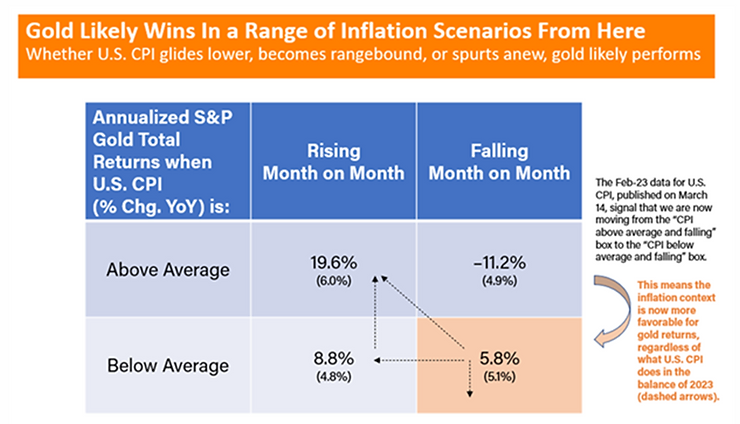
We have been bullish gold for the past year (Gold likely works whether inflation slides, ranges, or surges, 15-Mar-2023). As we wrote in that initiation note a year ago, our returns expectation has been: “we would expect gold to produce a total return in the 6% to 9% annualized range while also bringing hedging benefits into the portfolio” (Fig. 4).
Once gold breached its previous all-time nominal price high on 4-Dec-2023, we increased our +6 to +9% per annum spot price view to an expectation of a +10 to +15% per annum spot price regime.
In the event, over the past year the LBMA gold bullion spot price has advanced by +11.4% from Feb. 28, 2023 to Feb. 28, 2024 and by +13.3% from Mar. 14, 2023 to Mar. 14, 2024. So, realized performance has been a modestly strong beat on our expectation as of a year ago and consistent with our projections as of December 2023.
In the year through last night, the CMX gold front-month rolling continuous price (GC1) advanced by +13.4% from $1910 to $2167 per oz., with a +7.5% advance YoY through Feb. 29. Note that the Feb-Feb move was more consistent with our baseline forecast as of a year ago, whilst the Mar-Mar move confirms an acceleration occurred in the first half of March 2024, consistent with the new regime that began in December 2023.
The S&P GSCI Gold Total Return Index advanced by +10.6% in the year through Feb, 28, 2023 and by +12.9% through the year ending Mar. 14, 2024, also emphasizing the incremental strength of the past two weeks.
Our ongoing bullish call on gold (the commodity) implies that the share prices of miners should have upsides measured closer to +20% to +45% per annum through operating leverage effects, with rising conviction post the Dec-23 breakout in the commodity.
To be clear, this expectation means gold miners should be reentering their once-per-generation hotspots for significant outperformance. Our sense, however, is professional investors continue to shun this unloved sector. If this perception is correct, then bolder investors have a once-in-a-generation opportunity to acquire these shares at a unique discount to coming fair value. We emphasized this point in our meetings with investors in New York, Greenwich, and London last month.
Our Dec. 4 note ended with this conclusion on trading implications: “We maintain our favorable posture toward gold and silver (A silver lining for the copper/gold ratio, 26-Nov-2023).”
That assessment remains intact. “Long gold” is a durable investment theme which we believe will play out for at least the next three years. We believe risktakers will want to own gold futures, gold ETFs, and the shares of gold miners.
Fig. 1
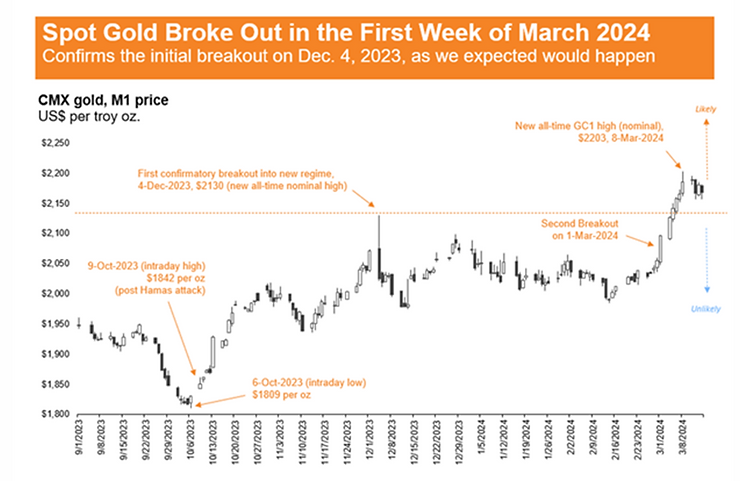
Source: CMX, Blacklight Research. Note: the punchline is gold entered a new multi-year bull price regime on 4-Dec-2023, reconfirmed on 5-Mar-2024.
Fig. 2
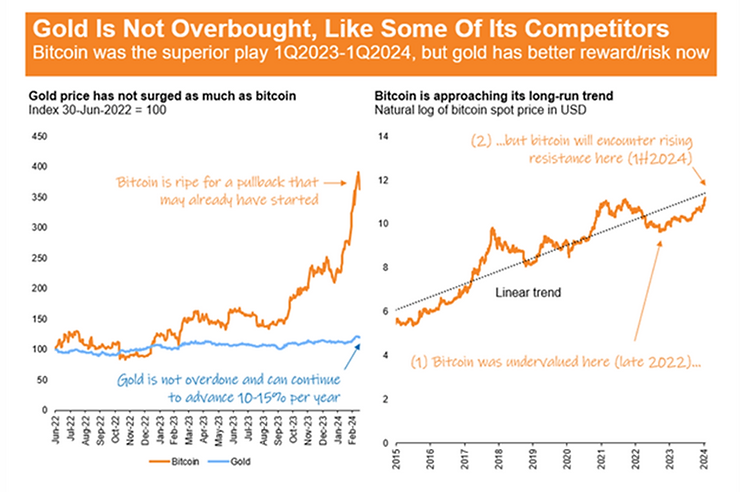
Source: CMX, Bloomberg, Blacklight Research.
Fig. 3
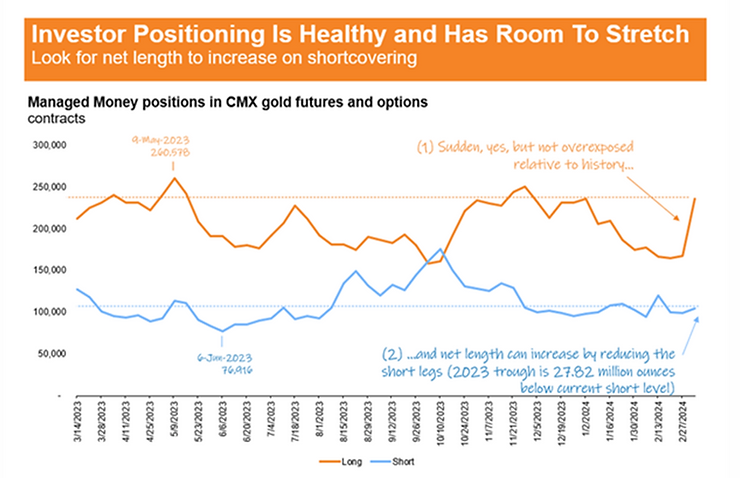
Source: CFTC, Blacklight Research.
Fig. 4 (republished from Gold works whether inflation slides, ranges, or surges, 15-Mar-2023)
Source: Blacklight Research.
This material is published by Blacklight Research, LLC (“Blacklight”) for informational, educational, and institutional research purposes only. All content has been compiled and presented as general market commentary and non-personalized research, without regard to the investment objectives, financial condition, risk tolerance, hedging needs, regulatory status, tax position, or other circumstances of any particular company, institution, fund, account, or individual. Nothing in this material is intended as, and nothing should be construed as, investment advice, trading advice, commodity trading advice, hedging advice, legal advice, tax advice, accounting advice, or any other form of individualized professional advice. This material is not an offer, solicitation, recommendation, endorsement, or invitation to buy, sell, subscribe for, hedge, or otherwise transact in any security, commodity, futures contract, option, swap, derivative, currency, index product, physical cargo, commercial contract, or other financial or commercial instrument. Any companies, securities, commodities, futures, options, swaps, contracts, indices, or strategies referenced herein are discussed solely for illustrative, analytical, or informational purposes. Blacklight is an independent publisher. Blacklight is not a broker-dealer, investment adviser, commodity trading advisor, commodity pool operator, futures commission merchant, introducing broker, swap dealer, or security-based swap dealer. Blacklight does not manage client assets, direct trading in securities or commodity interests, maintain discretionary authority over any account, execute or clear securities, futures, swaps, or other transactions, or provide individualized or customized investment, trading, hedging, or risk-management advice. Users are solely responsible for their own investment, trading, hedging, commercial, and risk-management decisions and actions, including any independent assessment of suitability, risk, liquidity, valuation, regulatory constraints, and legal obligations. Blacklight’s publications include macroeconomic analysis, commodity and market commentary, forward-looking assessments, geopolitical analysis, sector research, and other forms of substantive institutional research designed to assist clients in forming their own independent investment and commercial judgments. Blacklight’s publications may constitute research services that institutional clients may evaluate for eligibility under Section 28(e) of the Securities Exchange Act of 1934, subject to each client’s own good-faith determination and applicable law. Blacklight does not determine any client’s eligibility for Section 28(e) treatment and makes no representation that any client’s use of Blacklight research will qualify for such treatment. The information and opinions presented herein are based on data, market prices, company materials, government and regulatory publications, industry sources, news reports, third-party databases, proprietary data services, and other sources Blacklight deems to be reliable. Blacklight uses such sources in accordance with applicable license terms where relevant. Blacklight does not, however, make any representation, warranty, assurance, or guarantee, express or implied, as to the completeness, accuracy, timeliness, reliability, suitability, or availability of any information contained herein. Data may be incomplete, delayed, revised, restated, mis-transcribed, misinterpreted, or superseded. Any estimates, calculations, conversions, forecasts, scenarios, probabilities, and forward-looking assessments are based on assumptions that may prove incorrect and are subject to material uncertainty. The views expressed herein reflect Blacklight’s interpretations as of the date of publication and are subject to change without notice. All pricing, market data, and positioning data are as of the latest closing date prior to publication unless otherwise stated. Blacklight has no obligation to update, supplement, or revise this material after publication, or to notify any reader if any information, opinion, forecast, scenario, or assumption changes; however, Blacklight may, in its discretion, correct material errors that it identifies. Past performance is not necessarily indicative of future performance, and future results may differ materially from any historical performance, forecast, estimate, scenario, or projection discussed herein. Unless otherwise disclosed in the relevant publication, Blacklight and its principals, employees, contractors, or affiliates may hold positions in securities, commodities, futures, options, swaps, currencies, physical commodities, issuers, sectors, or instruments discussed, and such positions may change without notice. For this publication, Blacklight and the author(s) have disclosed any material financial conflicts they are aware of as of publication. No part of the compensation of any Blacklight analyst is determined by the specific views expressed in any publication or in any public or private meeting with clients. Trading, investing, hedging, or transacting in securities, commodities, futures, options, swaps, physical energy products, currencies, and related instruments involves substantial risk, including the possible loss of principal, liquidity risk, leverage risk, basis risk, volatility risk, counterparty risk, operational risk, regulatory risk, and the risk that market conditions change rapidly and unexpectedly. Commodity futures, options, swaps, and other derivatives may be unsuitable for many market participants and can involve losses exceeding initial margin or investment. Any discussion of hedging or risk management is general in nature and should not be interpreted as advice to implement or refrain from implementing any hedge, trade, or strategy. Any trade, shipment, financing, hedging, investment, commercial activity, or contractual arrangement involving affected regions, cargoes, vessels, counterparties, issuers, commodities, or instruments may be subject to sanctions, export controls, import controls, maritime law, market rules, exchange rules, position limits, anti-money-laundering rules, anti-corruption laws, and other legal or regulatory requirements. Readers are responsible for obtaining their own legal, regulatory, tax, accounting, compliance, and commercial advice before taking any action. This material may discuss war, terrorism, sanctions, geopolitical conflict, maritime incidents, physical infrastructure damage, or other events with serious human, security, and humanitarian consequences. Such discussion is included solely for the purpose of analyzing potential market, economic, commercial, and policy implications. Blacklight does not intend to minimize human suffering, endorse any political or military action, or attribute responsibility beyond the sources and analysis cited or described in the relevant publication. Blacklight is not liable for any loss, damage, cost, expense, or other consequence arising directly or indirectly from reliance on this material or any other content published by Blacklight. Blacklight’s research is published broadly and contemporaneously to clients and is not tailored to specific portfolio needs. Publications are distributed electronically by email and through website portals; delivery times may vary due to factors beyond Blacklight’s control. Blacklight does not provide client-specific versions of its publications, preferential access to unpublished research, or individualized follow-up advice tailored to any subscriber’s portfolio, trading book, hedging program, risk limits, tax position, or commercial exposure. This material is for the recipient’s personal or institutional internal use only and may not be copied, reproduced, modified, excerpted, distributed, redistributed, forwarded, posted, transmitted, or otherwise shared, in whole or in part, without Blacklight’s prior written consent. Cover art, charts, graphics, tables, photographs, and other visual materials are Blacklight intellectual property, generated materials, licensed content, public-domain content, or materials otherwise used in accordance with applicable law. All rights are reserved.