
Oil Refiners’ Answer: Ninety-Eight Percent

The American refining system ran at 98 percent of capacity last week, which is the essential answer to the question President Trump put to a dozen refining executives in the Cabinet Room on Tuesday afternoon. He asked them how to raise domestic production of gasoline and diesel. The truth: there is no material reserve of idle capacity to call upon.
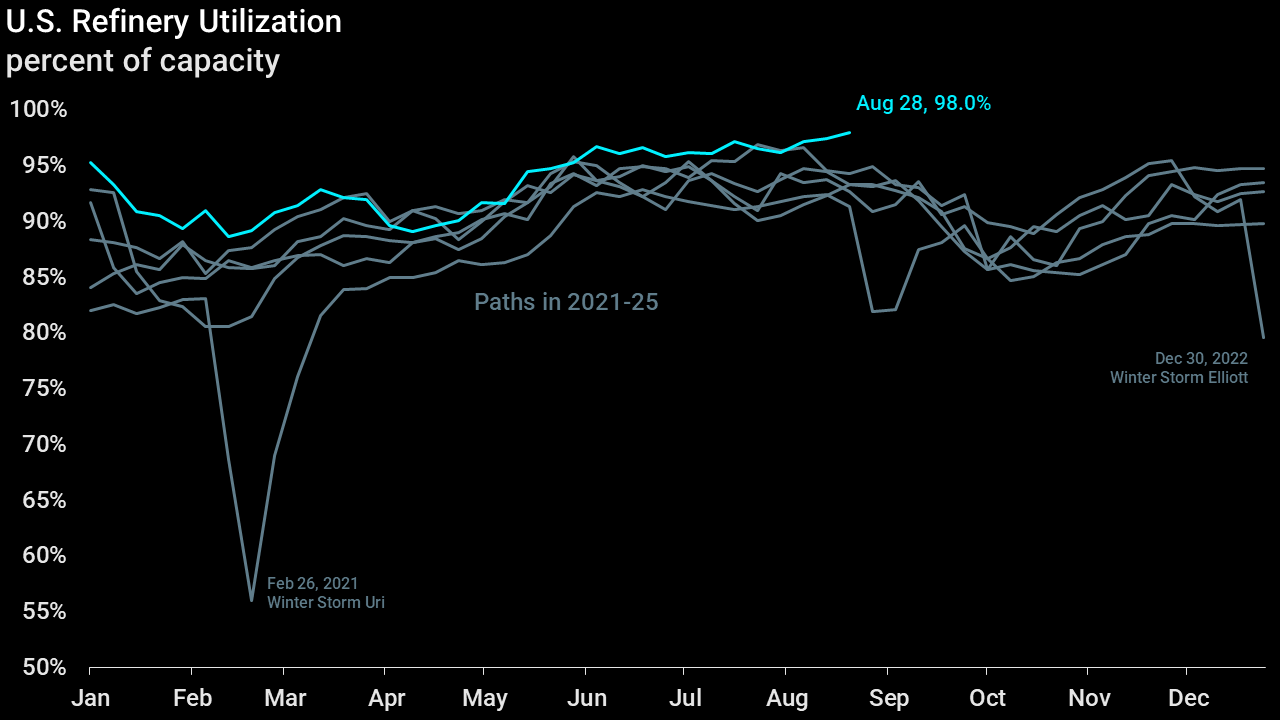
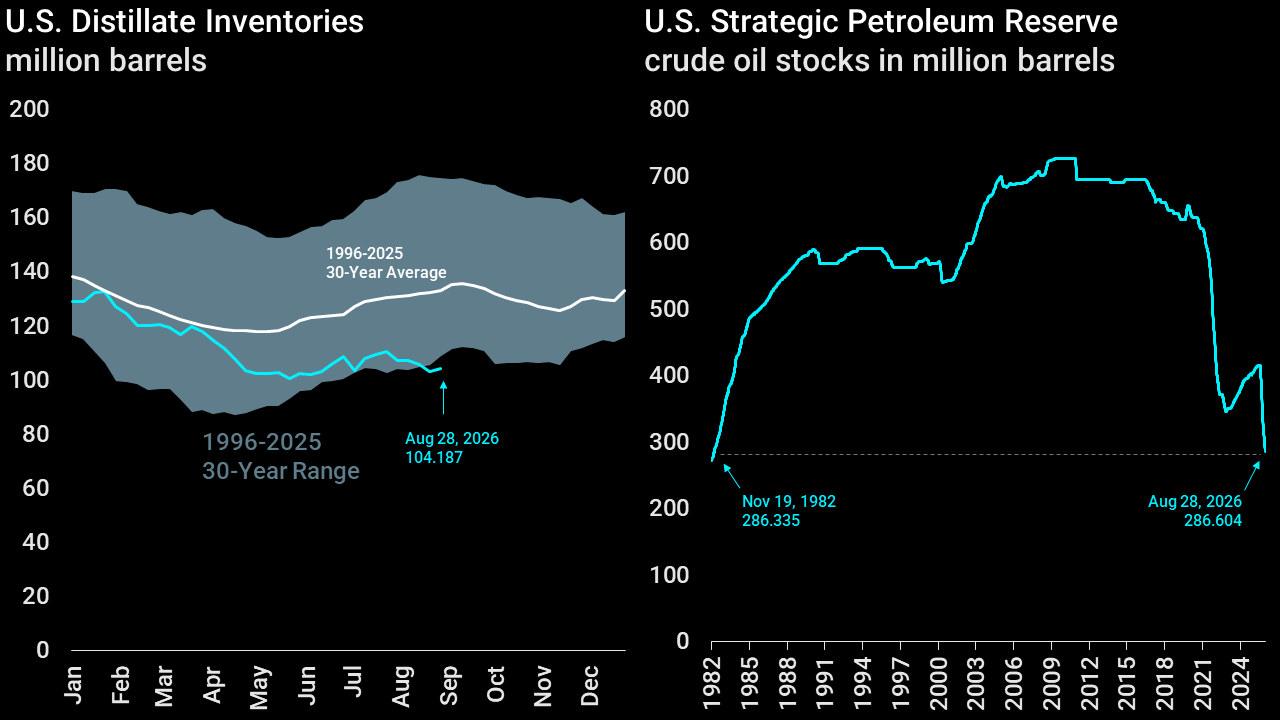
Refinery runs averaged 17.5 million b/d in the week ended August 28, up 102 thousand b/d on the week, according to the latest EIA data. Distillate stocks sit 14 percent below the five-year average after touching 103.4 million barrels on August 21, the lowest reading for that week in a series that begins in the early 1980s. Gasoline sits 6 percent below its five-year average. Commercial crude stocks drew 4.5 million barrels to 424.5 million. That’s close to the five-year average, which might be reassuring were it not for the 129-million-barrel draw from the Strategic Petroleum Reserve since March (more than 30 percent of the prewar total) that has brought emergency reserves to their lowest level since November 19, 1982. The system is converting everything it can reach into product and is still losing ground on the products that matter most to the American consumer.
The shortage has been accentuated by events eight thousand miles from the Cabinet Room. On the same Tuesday as the White House meeting, U.S. Central Command struck roughly 100 IRGC targets and U.S. drones hit the engine rooms of two Iranian government tankers lying at anchor. The latter action reflects a new “tanker-for-tanker” retaliation policy. CENTCOM also said the U.S. naval blockade still strictly targets traffic entering and exiting Iranian ports and internationally recognized shipping routes for non-conflict vessels remain open under U.S. military protection. Washington can support crude tankers willing to take the risk of running through the Strait in wartime conditions. It has no reach over what a hull costs to insure through it, nor over how many barrels an escort schedule can carry in a session, nor any ability to summon new refining capacity into instantaneous existence.
Three U.S. policy decisions arrived around the meeting at the White House. On August 31 the EPA decided 34 small refinery exemption petitions from Renewable Fuel Standard obligations for the 2025 compliance year, granting 18 in full and 11 at half, denying three and finding two ineligible, with the waived volumes proposed for reallocation to larger refiners. That would shift compliance demand onto nonexempt obligated parties but leaves the national blending obligation where it was. The Jones Act waiver extended for 90 days on August 10 makes it easier and cheaper to carry a Gulf Coast barrel to the East Coast, which narrows a regional basis without creating new supply. On August 31, Washington announced “the biggest oil deal in world history,” whereby Caracas grants to a U.S.-related entity “majority control” of more than 65 billion barrels of Venezuela’s proven oil reserves under a 100-year lease concession across 17 fields. Caracas says the agreed-upon lease is for 25 years. More pull on Venezuelan heavy crude into the U.S. Gulf Coast widens the discount that coking capacity captures but won’t move the needle on utilization. All three instruments (EPA waiver, Jones Act waiver, Venezuela concession) act on the input cost of turning a barrel into fuel. None of them adds a barrel of capacity to make consumer-facing products in markets carrying tight seasonal inventory coverage.
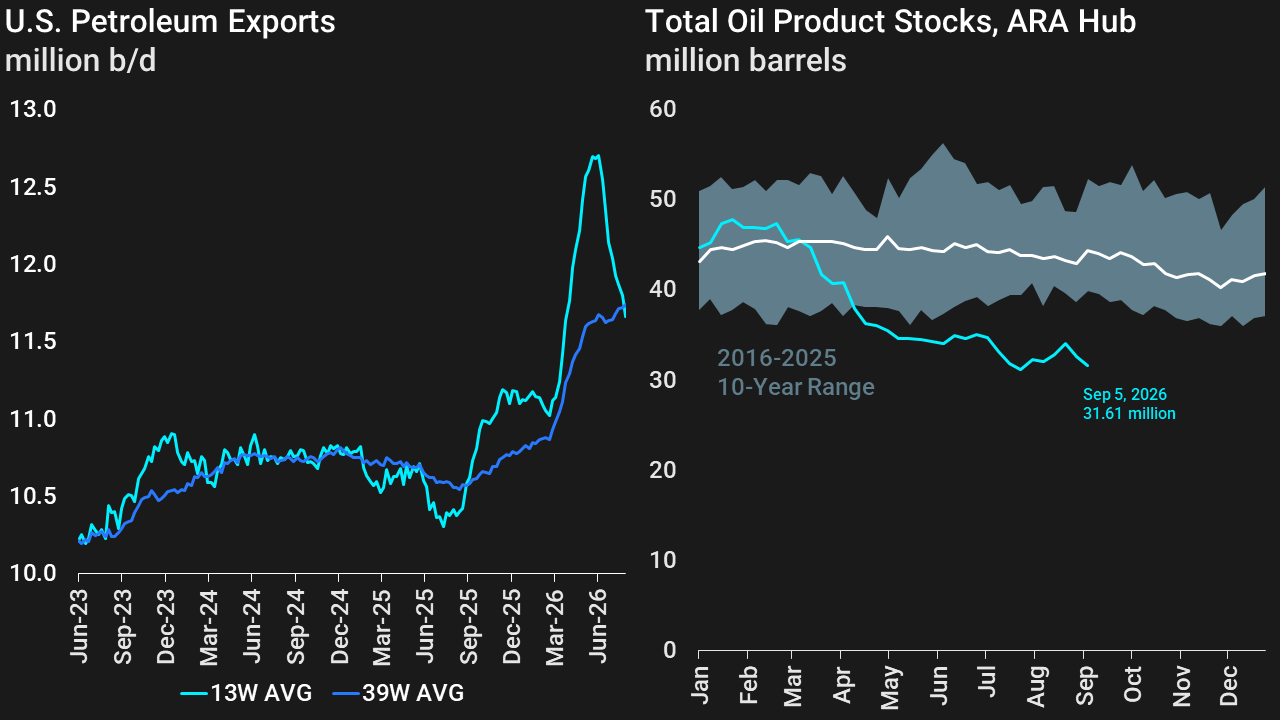
The idea of U.S. export controls on oil products has recurrently surfaced this summer as a potential solution. China and Russia have already pulled this lever for different reasons. The option sounds compelling to the American political ear but, if enacted, likely would soon prove to be a policy mistake. U.S. distillate exports set a record 1.9 million b/d in the week ended August 5, with northwest Europe the principal destination. Europe is short because seaborne diesel from Russia and the Middle East is running some 1.3 million b/d lower year over year, a disruption worth close to a fifth of the global seaborne trade on the IEA's August accounting. Total U.S. oil petroleum exports (crude plus products) surged to a record 14.2 million b/d in the week ended April 24 and averaged 11.9 million b/d last week, a gain of +1.3 million b/d (+12.1 percent) over the same week a year ago. Product exports averaged 8.0 million b/d over the past four weeks, +17.9 percent above a year earlier. Holding export barrels at home would lower the domestic crack but raise it everywhere else. In turn, the first effect on domestic prices would likely be short-lived and self-defeating as the second effect, rising global prices, boomeranged back into the U.S. domestic market through both crude and product import channels.
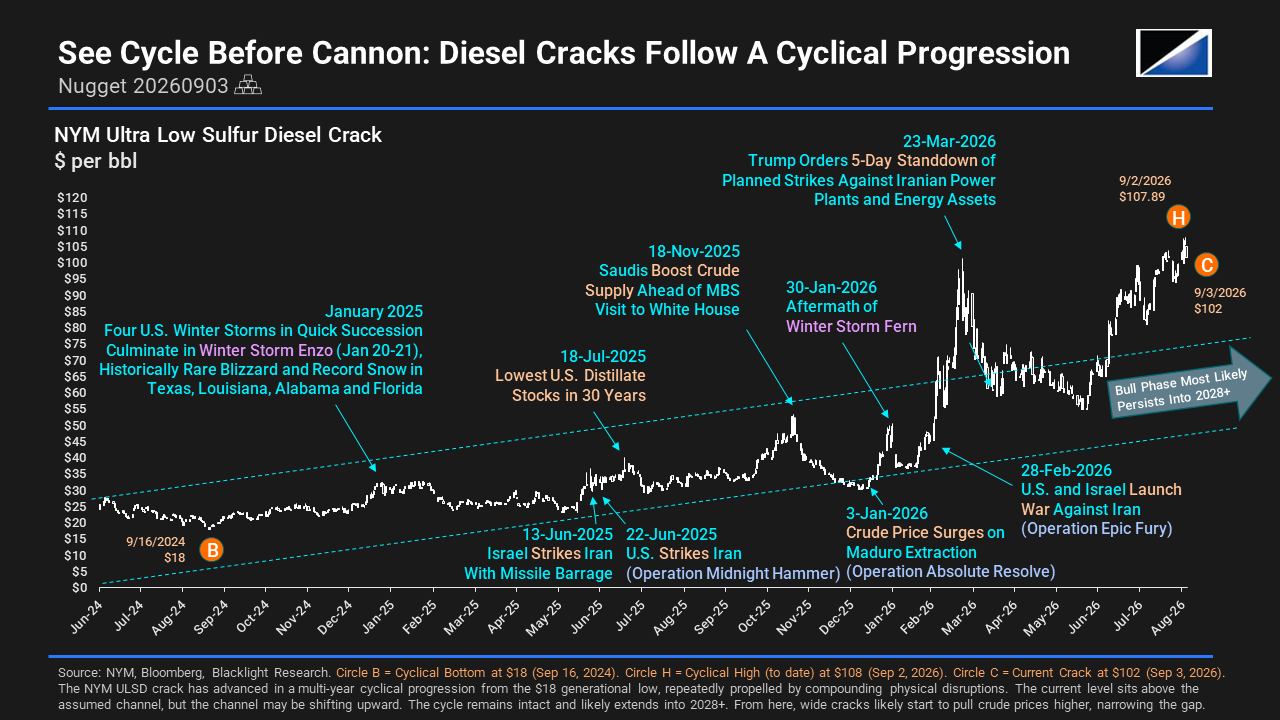
Markets have already read this reality. The prompt NYMEX ultra-low sulfur diesel crack against WTI settled at a record $106 per barrel on Tuesday and reached nearly $108 intraday yesterday. Valero’s share price made a fresh all-time high inside today’s session at $375.11. The S&P 500 Oil & Gas Refining & Marketing group is the top-performing of all subgroups in the S&P 500. Its total return is 124.1 percent YTD (Sep 3), nearly twice the total return of the second-ranked industry group and nearly nine times the S&P 500’s 14.0 percent total return, according to Bloomberg’s calculations.
The advance in diesel cracks and refiners’ valuations is fundamentally cyclical. The cyclical advance started in late 2024 near $25 (Abandoned Alpha, 8-Jan-2025), reached $33 by autumn 2025 (Refiners in the Sweet Spot, 28-Aug-2025, and Winning Portfolios Own Oil Products and Natural Gas, 5-Oct-2025), then $42 in February 2026 before the first missiles struck Iran (Video: 15 Minutes on Oil & Gas, 26-Jan-2026). The wars in Ukraine/Russia and Israel/Iran accelerated the move, but they were part of Blacklight’s framework from the outset, as we have tracked through Energy Outperformance Is a Cyclical Theme, Not Just Idiosyncratic Risk (1-Apr-2026), See Cycle Before Cannon: Diesel Cracks Follow a Cyclical Progression (3-Jun-2026), Quantifying Core and War in Refiners’ Cyclical Bull Market (15-Jul-2026), and The 100 Percent Repricing of Refining Capacity (14-Aug-2026).
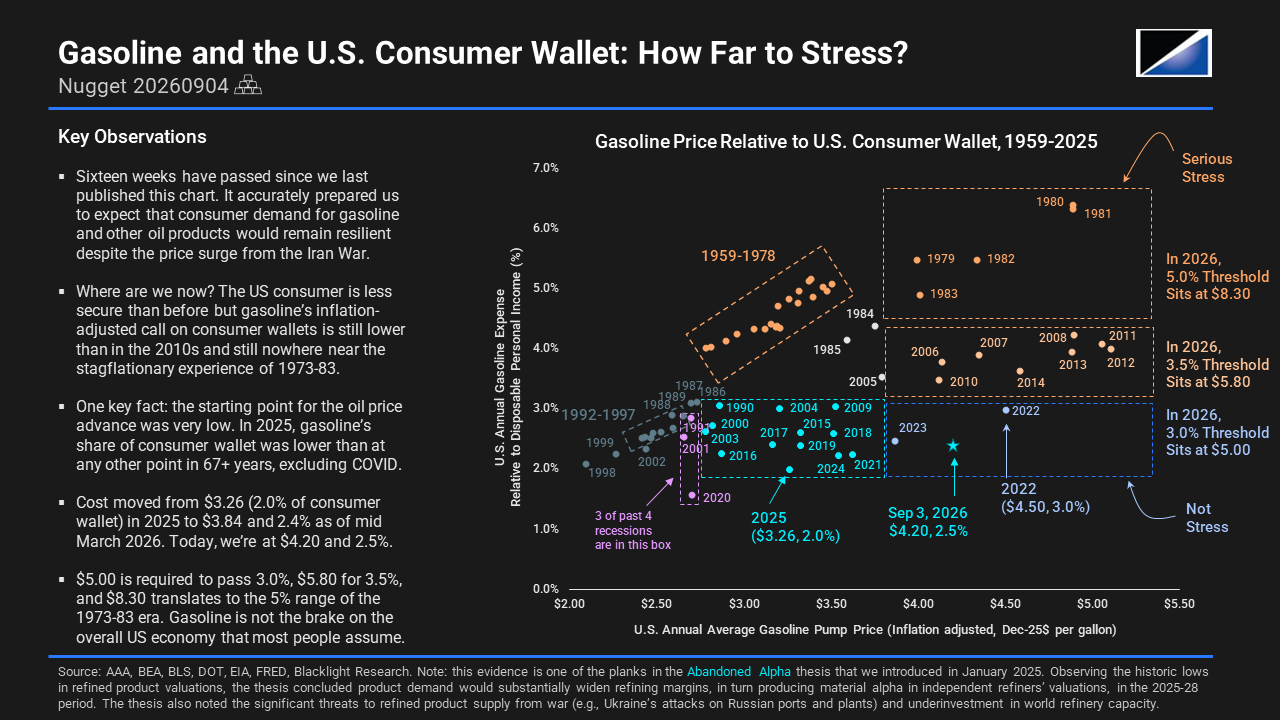
The president called the refining executives to the White House because nominal pump prices are high by the standards of recent memory. Yet gasoline remains inexpensive in inflation-adjusted terms and relative to disposable personal income. As we have pointed out over the past two years, gasoline expense as a share of the consumer wallet began this cycle near a 65-year low. That is why economy-wide demand remains relatively robust even at today’s prices. With consumer affordability still high and refinery slack exhausted, the marginal adjustment will likely come through higher prices.
That distinction matters for monetary policy. A shortage that lifts the relative price of fuel is not, by itself, the kind of generalized demand inflation that calls for a rate increase. A higher policy rate cannot refine another barrel. To the contrary, it would unhelpfully raise the hurdle rate on the debottlenecking, conversion, logistics, and replacement investment that the shortage is calling forward. Scarcity and the capital spending it requires are already exerting upward cyclical pressure on long yields. Raising short rates alongside them would flatten the curve and obstruct the energy supply response. Monetary policy should instead favor a lower front end and a steeper curve, allowing the return on scarce physical capacity to draw investment. At 98 percent utilization, the U.S. oil refining system has already delivered its instruction: rebuild the capacity margin.
This material is published by Blacklight Research, LLC (“Blacklight”) for informational, educational, and institutional research purposes only. All content has been compiled and presented as general market commentary and non-personalized research, without regard to the investment objectives, financial condition, risk tolerance, hedging needs, regulatory status, tax position, or other circumstances of any particular company, institution, fund, account, or individual. Nothing in this material is intended as, and nothing should be construed as, investment advice, trading advice, commodity trading advice, hedging advice, legal advice, tax advice, accounting advice, or any other form of individualized professional advice. This material is not an offer, solicitation, recommendation, endorsement, or invitation to buy, sell, subscribe for, hedge, or otherwise transact in any security, commodity, futures contract, option, swap, derivative, currency, index product, physical cargo, commercial contract, or other financial or commercial instrument. Any companies, securities, commodities, futures, options, swaps, contracts, indices, or strategies referenced herein are discussed solely for illustrative, analytical, or informational purposes. Blacklight is an independent publisher. Blacklight is not a broker-dealer, investment adviser, commodity trading advisor, commodity pool operator, futures commission merchant, introducing broker, swap dealer, or security-based swap dealer. Blacklight does not manage client assets, direct trading in securities or commodity interests, maintain discretionary authority over any account, execute or clear securities, futures, swaps, or other transactions, or provide individualized or customized investment, trading, hedging, or risk-management advice. Users are solely responsible for their own investment, trading, hedging, commercial, and risk-management decisions and actions, including any independent assessment of suitability, risk, liquidity, valuation, regulatory constraints, and legal obligations. Blacklight’s publications include macroeconomic analysis, commodity and market commentary, forward-looking assessments, geopolitical analysis, sector research, and other forms of substantive institutional research designed to assist clients in forming their own independent investment and commercial judgments. Blacklight’s publications may constitute research services that institutional clients may evaluate for eligibility under Section 28(e) of the Securities Exchange Act of 1934, subject to each client’s own good-faith determination and applicable law. Blacklight does not determine any client’s eligibility for Section 28(e) treatment and makes no representation that any client’s use of Blacklight research will qualify for such treatment. The information and opinions presented herein are based on data, market prices, company materials, government and regulatory publications, industry sources, news reports, third-party databases, proprietary data services, and other sources Blacklight deems to be reliable. Blacklight uses such sources in accordance with applicable license terms where relevant. Blacklight does not, however, make any representation, warranty, assurance, or guarantee, express or implied, as to the completeness, accuracy, timeliness, reliability, suitability, or availability of any information contained herein. Data may be incomplete, delayed, revised, restated, mis-transcribed, misinterpreted, or superseded. Any estimates, calculations, conversions, forecasts, scenarios, probabilities, and forward-looking assessments are based on assumptions that may prove incorrect and are subject to material uncertainty. The views expressed herein reflect Blacklight’s interpretations as of the date of publication and are subject to change without notice. All pricing, market data, and positioning data are as of the latest closing date prior to publication unless otherwise stated. Blacklight has no obligation to update, supplement, or revise this material after publication, or to notify any reader if any information, opinion, forecast, scenario, or assumption changes; however, Blacklight may, in its discretion, correct material errors that it identifies. Past performance is not necessarily indicative of future performance, and future results may differ materially from any historical performance, forecast, estimate, scenario, or projection discussed herein. Unless otherwise disclosed in the relevant publication, Blacklight and its principals, employees, contractors, or affiliates may hold positions in securities, commodities, futures, options, swaps, currencies, physical commodities, issuers, sectors, or instruments discussed, and such positions may change without notice. For this publication, Blacklight and the author(s) have disclosed any material financial conflicts they are aware of as of publication. No part of the compensation of any Blacklight analyst is determined by the specific views expressed in any publication or in any public or private meeting with clients. Trading, investing, hedging, or transacting in securities, commodities, futures, options, swaps, physical energy products, currencies, and related instruments involves substantial risk, including the possible loss of principal, liquidity risk, leverage risk, basis risk, volatility risk, counterparty risk, operational risk, regulatory risk, and the risk that market conditions change rapidly and unexpectedly. Commodity futures, options, swaps, and other derivatives may be unsuitable for many market participants and can involve losses exceeding initial margin or investment. Any discussion of hedging or risk management is general in nature and should not be interpreted as advice to implement or refrain from implementing any hedge, trade, or strategy. Any trade, shipment, financing, hedging, investment, commercial activity, or contractual arrangement involving affected regions, cargoes, vessels, counterparties, issuers, commodities, or instruments may be subject to sanctions, export controls, import controls, maritime law, market rules, exchange rules, position limits, anti-money-laundering rules, anti-corruption laws, and other legal or regulatory requirements. Readers are responsible for obtaining their own legal, regulatory, tax, accounting, compliance, and commercial advice before taking any action. This material may discuss war, terrorism, sanctions, geopolitical conflict, maritime incidents, physical infrastructure damage, or other events with serious human, security, and humanitarian consequences. Such discussion is included solely for the purpose of analyzing potential market, economic, commercial, and policy implications. Blacklight does not intend to minimize human suffering, endorse any political or military action, or attribute responsibility beyond the sources and analysis cited or described in the relevant publication. Blacklight is not liable for any loss, damage, cost, expense, or other consequence arising directly or indirectly from reliance on this material or any other content published by Blacklight. Blacklight’s research is published broadly and contemporaneously to clients and is not tailored to specific portfolio needs. Publications are distributed electronically by email and through website portals; delivery times may vary due to factors beyond Blacklight’s control. Blacklight does not provide client-specific versions of its publications, preferential access to unpublished research, or individualized follow-up advice tailored to any subscriber’s portfolio, trading book, hedging program, risk limits, tax position, or commercial exposure. This material is for the recipient’s personal or institutional internal use only and may not be copied, reproduced, modified, excerpted, distributed, redistributed, forwarded, posted, transmitted, or otherwise shared, in whole or in part, without Blacklight’s prior written consent. Cover art, charts, graphics, tables, photographs, and other visual materials are Blacklight intellectual property, generated materials, licensed content, public-domain content, or materials otherwise used in accordance with applicable law. All rights are reserved.