
The Cost of Time Drove the Silver and Gold Price Plunge
Warsh’s Nomination is an Excuse, Not the Reason
February 2, 2026

Executive Summary
- On Fri Jan 30, gold and silver prices plummeted by their largest daily percentage changes since modern trading in COMEX precious metals futures began in 1975. Gold slumped by 11.4%. Silver dived by 31.4%. The prior largest declines took place in March 1980: –9.4% and –21.8% respectively. Also like March 1980: the historic swoons had been preceded and primed by historically large daily advances amid a powerful monthly rally. Silver’s +14.0% daily gain on Jan 26 is the 4th largest ever, by our calculations.
- Just ahead of the price plunges, rumors emerged (later confirmed) that President Trump had selected Kevin Warsh as his choice to become next chair of the Federal Reserve.
- Conventional wisdom quickly connected the two stories to the exclusion of others. By the end of the day, the narrative had cemented to a stronger form of causality. It said: gold shed $600 per oz and silver dived by $35 per oz because of Kevin Warsh’s Fed nomination.
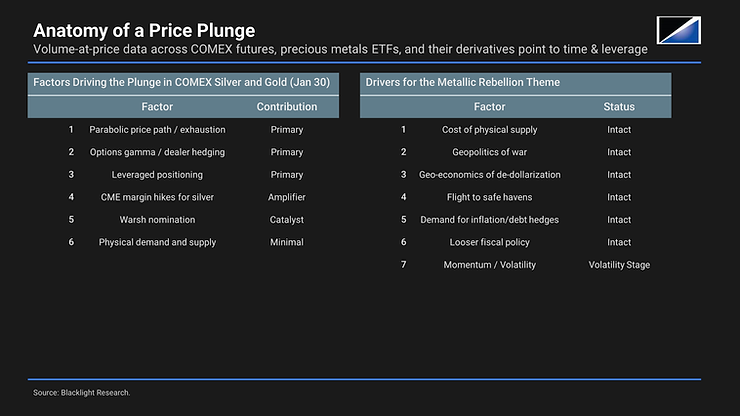
- There is a kernel of truth in that claim, which we will revisit below, but it fundamentally misdiagnoses cause and effect. It also implies a regime shift for monetary policy, the value of the U.S. dollar, and precious metals prices that we assess to be a wrong read. The Warsh announcement was a catalyst, not the cause. It’s an excuse, not the reason.
- One dominant factor that must not be overlooked: investor and dealer positioning in commodity futures (gold, silver), ETF shares (GLD, SLV), and the associated options markets across both asset classes. Open interest at key strikes in soon-to-expire commodity and equity derivatives surged in recent weeks, packing a powder keg of leverage. Time to monetize value, as always, decayed rapidly into the Jan 30 first notice day for the Feb-26 COMEX futures contracts, when futures holders must decide whether to take physical delivery or roll positions. Jan 30 also happened to be a Friday and a month end. The extraordinary price action reflects hurried liquidation of leveraged positions at risk racing a clock.
- Warsh’s appointment lit a fuse. But it did not create the keg or the match…or the calendar.
- Bottom line: this was a historic positioning event, but it is not a regime change. The once-in-a-generation Metallic Rebellion in precious metals specifically, and the bull markets in commodities more generally, are nowhere near done yet. The violent volatility is a tell that commodity price forecasts should be getting marked up, not down.
Positioning Matters
Risk metrics in frothy precious metals derivatives markets were blaring warning signals in the week before the Jan 30 selloffs (Nugget, Jan 23).
Among cautionary price signals for prompt COMEX silver (SI1), for example, at-the-money implied volatility surged from 75% (Jan 23) to 109% (Jan 29).
Over the same interval, while the 25-delta call skew was steady (at a breathtaking +12 vols), the underlying strikes showed considerable motion. They moved from $88 to $98 on the put side and from $118 to $148 on the call side.
Relative strength (RSI-14) was already overbought (73.52) and started to waver by end of the period, slipping to 72.02 on Jan 29.
The Moving Average Convergence Divergence (MACD) chart advanced from 8.64 (+1.20 points above its signal line, Jan 23) to 11.47, a strained +2.02 points above its signal line at the Jan 29 close. For reference, MACD and spread to signal reversed to 8.85 (–0.48 points) on Jan 30.
Likewise, positioning metrics became increasingly overextended. While it is normal for open interest (OI) in an April gold futures contract to pick up rolls after a December contract expiry, OI in Apr-26 COMEX gold (GCJ6) increased rapidly. OI started the year at 67,485 lots and surpassed 100,000 lots by Jan 8 (102,305). It then more than doubled in the two weeks between Jan 13 (147,468 lots) and Jan 27 (304,601 lots), before reaching 314,230 lots on Jan 28.
Then, a warning shot: the first daily contraction in GCJ6 OI since Nov 17, 2025 (–6,937 lots, Jan 29). For reference, the size of this contraction was nearly as large (93%) as the GCJ6 OI contraction that occurred during the price plunge the next day (–7,434 lots, Jan 30).
It was in this context that prompt COMEX silver (SI1) surpassed the $100 threshold for the first time in history on Fri Jan 23 to settle at $101.33. As Feb-26 COMEX gold and silver options then expired on Mon Jan 26, prompt COMEX gold (GC1) surpassed the $5,000 threshold for the first time ever and closed at $5,082. SI1 vaulted by another +14.0% to make its fourth-largest daily advance in percentage terms since modern trading in COMEX silver futures began in 1975.
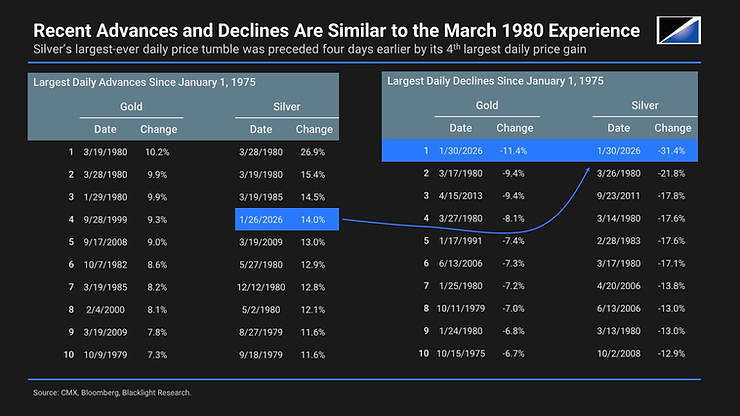
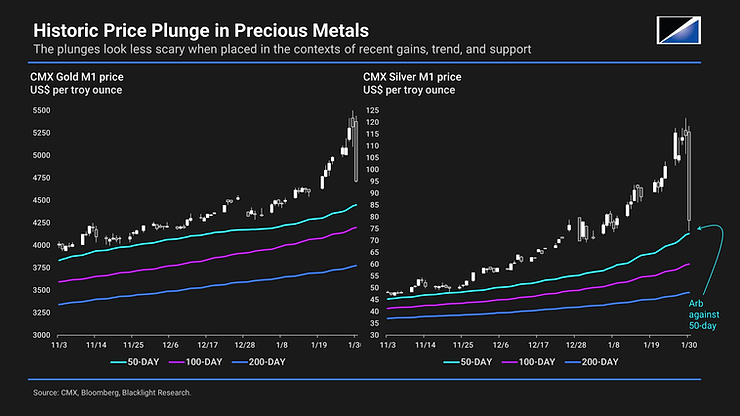
Over the subsequent three days, COMEX futures prices advanced with increasing acceleration. Between its intraday low on Tue Jan 27 and intraday high on Thu Jan 29, SI1 jumped by nearly $19 to surpass the $120 mark. Just this price change alone is equal to more than one half of SI1’s closing price seven months ago (Quicksilver gets quicker: long silver trade is now activated, 5-Jun-2025).
GC1, having surpassed $4,000 for the first time ever just three months earlier and $5,000 three days earlier, added another $500 to reach $5,586 at its intraday high on Jan 29.
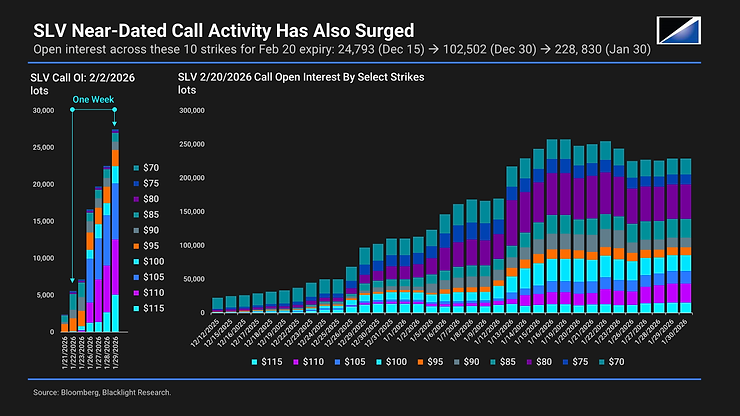
Equity derivatives exhibited a comparably manic acceleration. In the one week between Jan 22 and Jan 29, open interest boomed in the very short-dated 2/2/2026 calls on iShares Silver Trust (SLV). Open interest for strikes at $5 intervals between $70 and $115 (inclusive, both ends) surged from 5,549 to 27,430. That’s a fivefold increase in five days. By Friday Jan 30, these positions had less than two trading days of remaining life before their expiry.
Dump Day: January 30
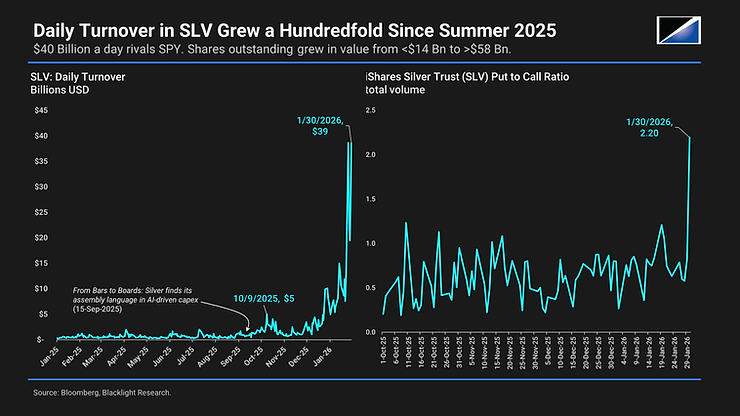
Rapid sales of call options to serve customer demand forces dealers to make rapid purchases in underlying instruments to hedge their own risk. One measure of the scale of recent customer enthusiasm for silver is the SLV put-to-call ratio. It rapidly dropped from 1.21 (Jan 19) to 0.58 (Jan 28). A falling ratio indicates that calls are becoming more plentiful than puts in traded volumes (lots).
Likewise for the obverse relationships. When customers wish to make rapid sales of calls and/or purchase of puts, dealers must make rapid sales in underlying instruments to hedge their own risk.
A rapid and powerful price ascent can operate in reverse with devastating speed, as cleared trades cascade through progressively lower strike levels and motivate customer selling that begets more selling by investors and dealers, all seeking to minimize their losses. The technical term in options trading circles for this whirlpool effect is “negative gamma”.
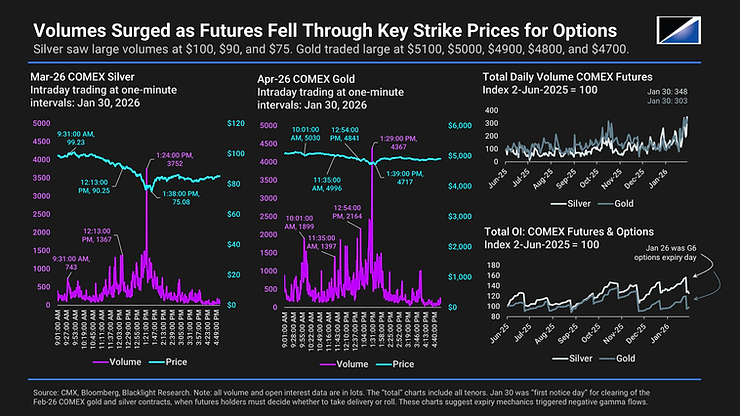
This kind of reversal is precisely what happened on Fri Jan 30 for multiple, overlapping reasons. Five factors stand out:
- First Notice Day for COMEX: Jan 30 was first notice day for the Feb-26 COMEX gold and silver contracts, when futures holders must decide whether to take physical delivery or roll. With large positions sensitive to the $5300, $5200, and $5100 levels, there were strong incentives for newly-arrived tourists to exit.
- An Expiry Day for GLD: Jan 30 was also expiry day for a large tranche of GLD calls struck at $465 and $455. Price began the day above $495.
- Calendar Squaring: Jan 30 was end of week and end of month.
- More Expiry Days for GLD and SLV: Imminent expiry of GLD and SLV 2-Feb-2026 options sitting on the other end of the weekend.
- Margin Calls: CME raised margin requirements with an effective date of Feb 2, following earlier increases that already strained positions.
These factors alone were sufficient to get a snowball rolling. And did.
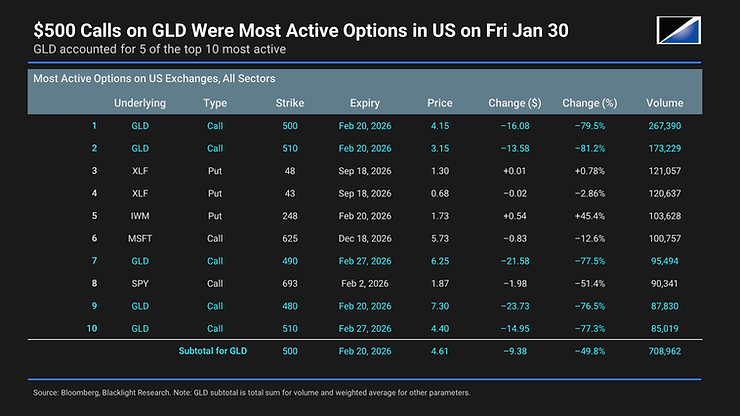
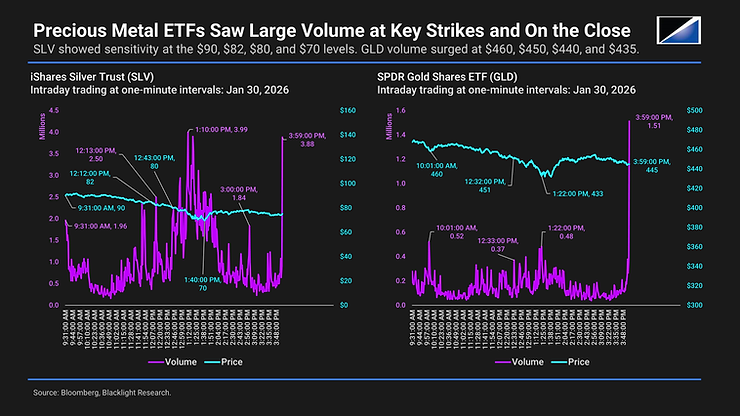
The snowball was not small. On Jan 30, the most actively traded equity options across all sectors on all exchanges in the United States were GLD’s 20-Feb-2026 $500 calls. Volume was 267,390. GLD also accounted for the second most actively traded options: the 20-Feb-2026 $510 calls (173,229 lots). Indeed, GLD accounted for 5 of the top 10 spots on the options activity leaderboard (below). The others were Feb 27 $490 calls, Feb 20 $480 calls, and Feb 27 $510 calls. Volume in just these five GLD options alone surpassed 700K lots. The weighted-average strike was $500 and the weighted average daily decline in options price was 50% by our calculations.
Within all options trading of GLD, trading in calls dominated, accounting for nine of the top 10 instruments traded by volume on Jan 30. The only puts in the top 10 by volume were the 15-Jan-27 $335s. Other active puts were the 6-Mar-2026 $390s, 13-Mar-2026 $390s, 15-Jan-2027 $500s, and 6-Feb-2026 $460s.
Warsh: Catalyst, Not Cause
The news of Kevin Warsh’s nomination broke on Jan 30 at 6:48 AM ET in a social media post. By that time, GCJ6 OI had already completed its first daily contraction in more than two months. Relative strength in COMEX had already begun to shiver. First notice day for COMEX and expiry for 30-Jan-2026 GLD calls had already been set in stone long before.
The historic plunge in precious metals was already in motion. But fear is a coward who looks for concrete catalysts before swinging from anxious fear of missing out to manic get me out. In this instance, fear latched on to Warsh’s nomination.
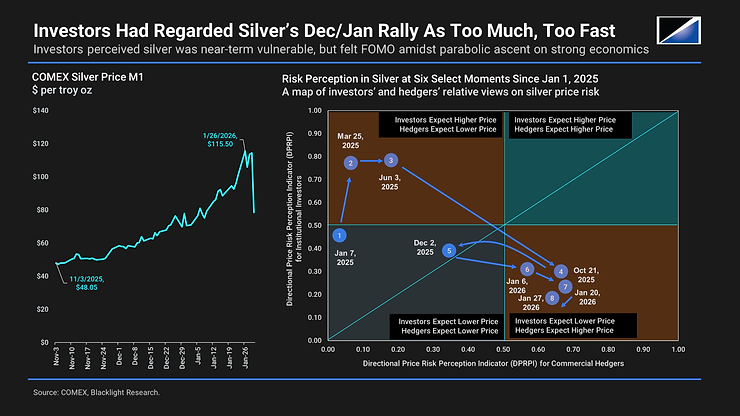
Warsh is well known and well respected on Wall Street. Like US Treasury Secretary Bessent, who moves in the same macro circles, Warsh is both an institutionalist and a realist. He has been a hawk who promotes discipline. He has been a pragmatist who compromises to achieve reasonable goals. He demonstrates a willingness to evolve his opinions over time in response to new facts (on crypto, for example). Like many leaders who ascend to an apex in the American political economy, he may be surprised that his expected mission (manage inflation and debt) turns out to be another (manage labor in the AI era).
The simple narrative that built on Friday is Warsh will promote an independent Fed and a strong USD regime that will hurt precious metals.
This assertion is too glib. In the short term, especially, Warsh’s coming installment is more USD dovish than Powell’s resistance. Trump’s public browbeating of Powell (and the DOJ’s threat of “indictment”) produced the opposite of the intended effect. Powell could not cut policy rates without appearing to capitulate to political pressure, which would have permanently damaged Fed credibility and his own legacy. The institution’s independence became personally embodied in Powell’s resistance. The FOMC’s decision to hold rates on Wed Jan 28 was as much about preserving institutional dignity as it was about inflation readings.
Warsh changes this calculus. His FOMC can cut rates and frame the decision as independent judgment rather than submission to presidential demands. The irony is acute: Trump may get more accommodation from his “hawkish” appointee than he ever extracted from Powell, precisely because Warsh can deliver it without the political taint.
There is another underappreciated dimension with respect to quantitative easing (QE). Warsh’s skepticism of balance sheet expansion means rate cuts become the primary tool again. This development is more straightforwardly bullish for gold than the Bernanke-era toolkit, which created ambiguity about what “easy money” even meant.
Warsh’s appointment also does not exist in isolation. The same geopolitical instability that drove gold to $5,500 has not resolved. Iran is fragile and U.S. warships threaten to strike. Greenland tensions are ongoing. The Venezuela situation remains ad hoc. Trade war escalation risk is always one post away. Taiwan could finally come under attack. Ukraine and Russia are about to witness the fourth anniversary of invasion. Any one of these factors could break in such a way to send gold to fresh highs within days.
Friday’s price moves in precious metals derivatives were violent, but they were a point-in-time positioning event, not a regime change. The factors driving the Metallic Rebellion theme in gold and the Assembly Language theme in silver remain intact. After the corrections cool, we expect to see a renewed advance to new highs this year, barring emergence of lower-probability scenarios.
This material is published by Blacklight Research, LLC (“Blacklight”) for informational, educational, and institutional research purposes only. All content has been compiled and presented as general market commentary and non-personalized research, without regard to the investment objectives, financial condition, risk tolerance, hedging needs, regulatory status, tax position, or other circumstances of any particular company, institution, fund, account, or individual. Nothing in this material is intended as, and nothing should be construed as, investment advice, trading advice, commodity trading advice, hedging advice, legal advice, tax advice, accounting advice, or any other form of individualized professional advice. This material is not an offer, solicitation, recommendation, endorsement, or invitation to buy, sell, subscribe for, hedge, or otherwise transact in any security, commodity, futures contract, option, swap, derivative, currency, index product, physical cargo, commercial contract, or other financial or commercial instrument. Any companies, securities, commodities, futures, options, swaps, contracts, indices, or strategies referenced herein are discussed solely for illustrative, analytical, or informational purposes. Blacklight is an independent publisher. Blacklight is not a broker-dealer, investment adviser, commodity trading advisor, commodity pool operator, futures commission merchant, introducing broker, swap dealer, or security-based swap dealer. Blacklight does not manage client assets, direct trading in securities or commodity interests, maintain discretionary authority over any account, execute or clear securities, futures, swaps, or other transactions, or provide individualized or customized investment, trading, hedging, or risk-management advice. Users are solely responsible for their own investment, trading, hedging, commercial, and risk-management decisions and actions, including any independent assessment of suitability, risk, liquidity, valuation, regulatory constraints, and legal obligations. Blacklight’s publications include macroeconomic analysis, commodity and market commentary, forward-looking assessments, geopolitical analysis, sector research, and other forms of substantive institutional research designed to assist clients in forming their own independent investment and commercial judgments. Blacklight’s publications may constitute research services that institutional clients may evaluate for eligibility under Section 28(e) of the Securities Exchange Act of 1934, subject to each client’s own good-faith determination and applicable law. Blacklight does not determine any client’s eligibility for Section 28(e) treatment and makes no representation that any client’s use of Blacklight research will qualify for such treatment. The information and opinions presented herein are based on data, market prices, company materials, government and regulatory publications, industry sources, news reports, third-party databases, proprietary data services, and other sources Blacklight deems to be reliable. Blacklight uses such sources in accordance with applicable license terms where relevant. Blacklight does not, however, make any representation, warranty, assurance, or guarantee, express or implied, as to the completeness, accuracy, timeliness, reliability, suitability, or availability of any information contained herein. Data may be incomplete, delayed, revised, restated, mis-transcribed, misinterpreted, or superseded. Any estimates, calculations, conversions, forecasts, scenarios, probabilities, and forward-looking assessments are based on assumptions that may prove incorrect and are subject to material uncertainty. The views expressed herein reflect Blacklight’s interpretations as of the date of publication and are subject to change without notice. All pricing, market data, and positioning data are as of the latest closing date prior to publication unless otherwise stated. Blacklight has no obligation to update, supplement, or revise this material after publication, or to notify any reader if any information, opinion, forecast, scenario, or assumption changes; however, Blacklight may, in its discretion, correct material errors that it identifies. Past performance is not necessarily indicative of future performance, and future results may differ materially from any historical performance, forecast, estimate, scenario, or projection discussed herein. Unless otherwise disclosed in the relevant publication, Blacklight and its principals, employees, contractors, or affiliates may hold positions in securities, commodities, futures, options, swaps, currencies, physical commodities, issuers, sectors, or instruments discussed, and such positions may change without notice. For this publication, Blacklight and the author(s) have disclosed any material financial conflicts they are aware of as of publication. No part of the compensation of any Blacklight analyst is determined by the specific views expressed in any publication or in any public or private meeting with clients. Trading, investing, hedging, or transacting in securities, commodities, futures, options, swaps, physical energy products, currencies, and related instruments involves substantial risk, including the possible loss of principal, liquidity risk, leverage risk, basis risk, volatility risk, counterparty risk, operational risk, regulatory risk, and the risk that market conditions change rapidly and unexpectedly. Commodity futures, options, swaps, and other derivatives may be unsuitable for many market participants and can involve losses exceeding initial margin or investment. Any discussion of hedging or risk management is general in nature and should not be interpreted as advice to implement or refrain from implementing any hedge, trade, or strategy. Any trade, shipment, financing, hedging, investment, commercial activity, or contractual arrangement involving affected regions, cargoes, vessels, counterparties, issuers, commodities, or instruments may be subject to sanctions, export controls, import controls, maritime law, market rules, exchange rules, position limits, anti-money-laundering rules, anti-corruption laws, and other legal or regulatory requirements. Readers are responsible for obtaining their own legal, regulatory, tax, accounting, compliance, and commercial advice before taking any action. This material may discuss war, terrorism, sanctions, geopolitical conflict, maritime incidents, physical infrastructure damage, or other events with serious human, security, and humanitarian consequences. Such discussion is included solely for the purpose of analyzing potential market, economic, commercial, and policy implications. Blacklight does not intend to minimize human suffering, endorse any political or military action, or attribute responsibility beyond the sources and analysis cited or described in the relevant publication. Blacklight is not liable for any loss, damage, cost, expense, or other consequence arising directly or indirectly from reliance on this material or any other content published by Blacklight. Blacklight’s research is published broadly and contemporaneously to clients and is not tailored to specific portfolio needs. Publications are distributed electronically by email and through website portals; delivery times may vary due to factors beyond Blacklight’s control. Blacklight does not provide client-specific versions of its publications, preferential access to unpublished research, or individualized follow-up advice tailored to any subscriber’s portfolio, trading book, hedging program, risk limits, tax position, or commercial exposure. This material is for the recipient’s personal or institutional internal use only and may not be copied, reproduced, modified, excerpted, distributed, redistributed, forwarded, posted, transmitted, or otherwise shared, in whole or in part, without Blacklight’s prior written consent. Cover art, charts, graphics, tables, photographs, and other visual materials are Blacklight intellectual property, generated materials, licensed content, public-domain content, or materials otherwise used in accordance with applicable law. All rights are reserved.