
Hyperscalers Carve the Mineface: Securing Copper and Silver From Ore Body to Data Center
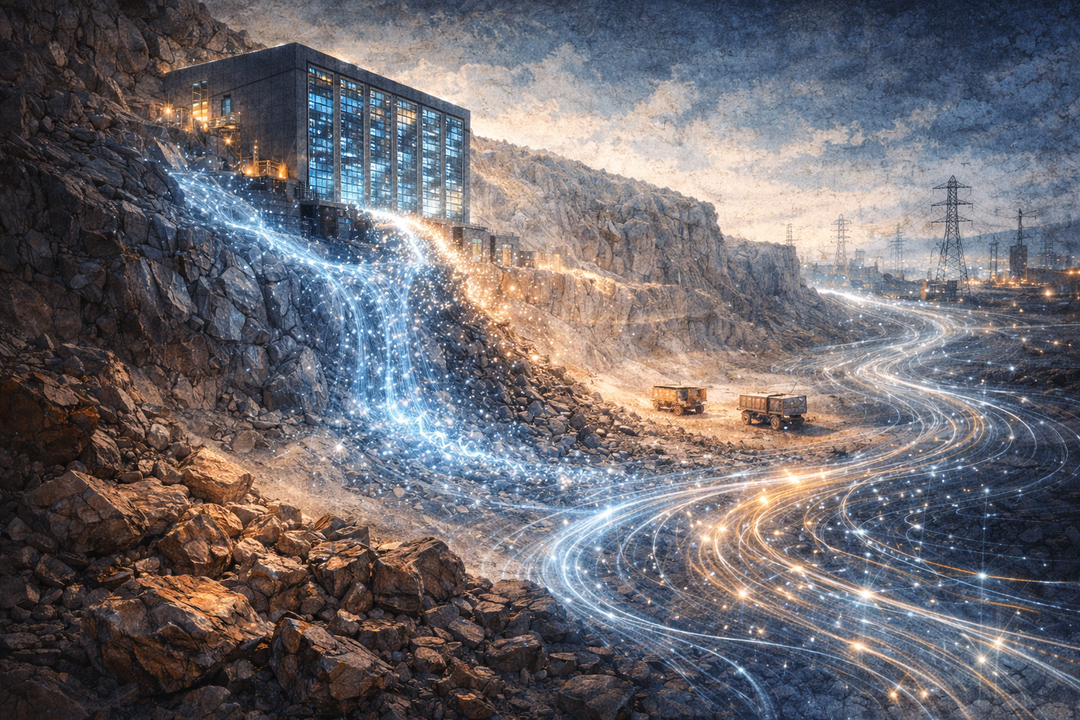
Executive Summary
- The hyperscalers are fundamentally restructuring global copper and silver supply chains as they steer explosive growth in artificial intelligence infrastructure. Faced with projected world supply deficits exceeding 600 thousand metric tonnes (kmt) of copper annually by 2030 or sooner and lead times for critical electrical equipment stretching beyond four years, Amazon, Google, Microsoft, Meta, and their peers are bypassing traditional commodity procurement channels through three distinct vertical integration strategies: (1) direct offtake agreements with mining operations at the extraction point, (2) equity investments in power generation and data center infrastructure, and (3) strategic procurement of long-lead electrical equipment years ahead of construction schedules.
- This transformation is driven by a large differential in commodity intensity of use. According to BHP and other miners, AI-optimized data centers require 27 to 33 tonnes of copper per megawatt (more than double the 10 to 15 tonnes required by traditional facilities) alongside 2 to 3 times the silver content in electrical contacts, cooling systems, and high-frequency interconnects. With hyperscalers now projected to deploy more than $600 billion in capital expenditure during 2026 alone (of which approximately 75% will be AI-specific infrastructure investment), the competition for copper-intensive transformers, switchgear, and power distribution equipment has evolved from a procurement challenge into an existential constraint on AI deployment velocity.
- The Amazon Web Services (AWS) partnership with Rio Tinto, announced in January 2026, exemplifies the new paradigm. AWS is the inaugural customer for copper extracted via advanced bioleaching technology from Arizona's Johnson Camp mine (one of the first new U.S. copper production sources in over a decade) while simultaneously providing cloud analytics to optimize the mining operation itself. Google's $4.75 billion acquisition of energy developer Intersect Power extends vertical integration into generation assets, eliminating traditional utility intermediaries and collapsing multi-year interconnection queues into direct co-location models. These moves signal that major technology firms now view upstream commodity control as strategically equivalent to semiconductor or software stack ownership.
AI Infrastructure Demands Reshape Copper Economics
The architectural requirements of artificial intelligence (AI) workloads have created an inflection point in industrial copper consumption that rivals historical demand shocks from rural electrification or telecommunications infrastructure buildouts. Modern AI data centers function as power conversion facilities first and computing environments second, with each rack housing GPU clusters that draw 30 to 80 kilowatts continuously, approximately 10 times the power density of traditional server configurations. This extreme power requirement cascades through every electrical system in the facility, driving copper intensity to unprecedented levels.
A single hyperscale AI campus operating at 500 megawatts (increasingly the baseline scale for frontier model training facilities) requires over 15 thousand metric tonnes (kmt) of copper for initial construction, distributed across power distribution busbars (which must be engineered 3x thicker than conventional designs to handle current loads without voltage drop), liquid cooling infrastructure incorporating copper cold plates directly interfaced with GPU die surfaces, uninterruptible power supply systems containing 30% to 40% more copper windings than traditional data center UPS units, and miles of heavy-gauge cabling connecting pad-mounted transformers to rack-level power distribution units.
An oft-repeated claim says a “study” found that Microsoft's $500 million data center facility in Chicago, constructed in 2009 before the current AI boom, used 2,177 tonnes of copper. Despite the ubiquity of this anecdote, we are skeptical of its accuracy. We have attempted to track down the alleged study without success. The closest potentially relevant material we have found is a 2009 SIGMETRICS tutorial by Microsoft researchers Greenberg and Maltz, which describes data center architecture and power infrastructure in detail, including costs, but contains no copper usage figures.
Given the Microsoft Chicago data center’s date of construction (2009) and capacity (80 MW), the asserted copper use would translate to 27 mt per MW, not the 10 to 15 mt per MW that one would expect for the era. Digging further it appears to us that an industry association commissioned an infographic from Visual Capitalist in October 2023 which inadvertently attached an AI-era intensity of use on a pre-AI era capacity number to arrive at the suspiciously specific 2,177-tonne number. In turn, once in the wild, this figure has virally reverberated through articles published by Bloomberg (August 2024), BHP (January 2025), Fastmarkets (February 2025), and others.
We do not believe there was any intentional deception here. It looks like a simple and honest mistake from 2023, but it is one you should be aware of when interpreting historical time series.
What we do know: today a 1GW facility demands 30,000 tonnes of refined copper or more. Coming larger, next-generation AI-specific facilities may approach 50,000 tonnes per site when accounting for redundant systems, future expansion capacity, and auxiliary infrastructure.
At the market level, this architectural transformation translates into structural demand that upends traditional demand patterns both on sectoral mix and geography. In fact, it creates a new regime altogether. Data center copper consumption will likely surpass 1.0 million tonnes next year, on our projections, meaning 3.5% of total global copper demand (and growing) will be from a single application vertical that barely registered in forecasting models five years ago. Moreover, baseline assumptions may prove conservative: they probably do not fully incorporate the potential impact of AI inference workloads, which are projected to overtake training requirements by 2027 and will drive geographic distribution of computing capacity to reduce latency.
Supply-Side Bottlenecks: From Ore to Cathode to Component
The copper supply chain faces simultaneous constraints at multiple processing stages, creating compounding delays that equipment manufacturers and data center developers are only recently recognizing as binding constraints. While mining industry attention focuses on long-term reserve replacement and declining ore grades (global average copper ore grades have fallen from above 1% in the 1980s to approximately 0.5% today), the more immediate bottleneck occurs at the smelting and refining interface where copper concentrate (typically 25% to 30% copper content) must be processed into copper cathode (99.99% pure) suitable for wire manufacturing.
In recent years, China has been the dominant hub in the copper midstream. UNCTAD notes China imports about 60% of global copper ore and produces more than 45% of the world’s refined copper (with some forecasts putting its refined share higher). This industrial organization creates geographic concentration that introduces systemic vulnerability to trade policy shifts, environmental regulations, and regional power availability. Meanwhile, refining capacity is expanding faster than concentrate supply.
This mismatch creates a supply gap in input materials that cannot be resolved through capacity utilization optimization alone. This structural deficit explains why copper concentrate treatment charges (TC/RCs), which reflect the balance of power between miners and smelters, have compressed dramatically, forcing some custom smelters to operate at reduced utilization rates despite surging downstream demand. The situation raises existential questions about whether legacy supply chains from the 2010s need to be reoptimized for the 2030s.
For data center developers, this mid-stream bottleneck manifests in transformer and switchgear lead times that have become the critical path for project completion. Large power transformers, which require hundreds of tonnes of copper in their windings and buswork, now face delivery schedules extending 144 weeks (nearly three years) for generator step-up units and 128 weeks for substation power transformers, or more than double the historical 52-to-60-week norm.
Distribution transformer lead times first spiked beyond 100 weeks in 2023. Circuit breakers, medium-voltage switchgear, and high-voltage cables saw comparable bottlenecking, with lead times reaching 151 weeks (nearly three years) for breakers and 24+ months for cable manufacturing, though averages have eased from peak levels in more recent tracking.
These delays stem from material scarcity at the most fundamental level: grain-oriented electrical steel (GOES), the specialized magnetic steel used in transformer cores, is produced domestically in the United States by only a single manufacturer: Cleveland-Cliffs’ Butler Works facility in Pennsylvania. Historically, more than 80% of U.S. large power transformer demand is met through imports, with Canada and Mexico frequently cited among the largest sources, but global capacity constraints have simultaneously tightened international supply while domestic manufacturing capacity cannot scale rapidly enough to close the gap.
Transformer production involves labor-intensive assembly processes that resist automation, requires individual design and testing for each unit, and depends on specialized transportation infrastructure. According to a Congressional Research Service study (admittedly from ten years ago), fewer than twenty super-heavy-load railcars exist in the U.S. capable of moving 100-to-400 tonne transformer units. Equipment manufacturers including Siemens Energy and GE Vernova report order backlogs of €146 billion and $150 billion, respectively. Industry sources have described gas turbine lead times stretching into the 5-to-7-year range in some cases, and GE Vernova has said it is sold out through 2028 and expects to be sold out through 2030 by the end of this year.
AWS and Rio Tinto: The Direct Mine Offtake Model
On January 15, 2026, AWS and Rio Tinto announced a two‑year collaboration under which AWS will be the first customer to use copper produced via Rio Tinto’s Nuton bioleaching technology at the Johnson Camp mine in Cochise County, Arizona. Rio Tinto and its partner have described a four‑year deployment plan targeting 30 kmt of refined copper in total (including 14 kmt associated with Nuton technology), but the parties have not publicly disclosed the specific tonnage contracted to AWS. Johnson Camp produced its first copper cathode in late August 2025, and Nuton-produced copper was achieved later in 2025.
The strategic significance extends beyond the tonnage figures, which represent only a fraction of the copper required for a single large hyperscale facility. The Nuton bioleaching technology is a nature-based extraction process that employs carefully cultivated microorganisms to dissolve copper from low-grade sulfide ores and mine waste that were previously deemed uneconomical to process through conventional smelting routes.
The bacteria-driven leach process generates exothermic heat as microorganisms oxidize minerals, creating favorable conditions for accelerated copper dissolution and achieving recovery rates up to 85% from primary sulfide ores. This performance substantially exceeds the industry standard of 60% to 70% for similar ore grades. The process produces 99.99% pure copper cathode directly on-site without requiring smelter or refinery infrastructure, while delivering environmental improvements. Rio Tinto reports lifecycle-style metrics for Johnson Camp refined copper produced using Nuton technology, including a carbon footprint of 2.82 kg CO₂e per kg copper and water intensity of 71 liters per kg copper (figures that are lower than many conventional pathways, though the exact percentage advantage depends on the baseline used).
Critically, the partnership structure incorporates bidirectional technology transfer: AWS is providing cloud computing infrastructure and advanced data analytics capabilities to optimize Nuton's biological leaching operations at Johnson Camp. This arrangement allows Rio Tinto to apply machine learning algorithms to simulate heap-leach performance, predict copper recovery rates based on ore characteristics and environmental variables, optimize acid and water application rates in real-time, and model the population dynamics of microbial communities to maximize dissolution kinetics. These tasks align naturally with AWS's core cloud infrastructure business, creating a symbiotic relationship where the mining operation receives technical capabilities unavailable from traditional equipment suppliers while AWS secures preferential access to low-carbon copper supply.
Chris Roe, Amazon’s Head of Energy and Sustainable Operations, articulated the company's procurement philosophy with unusual directness: "We work at the commodity level to find lower carbon solutions to drive our business growth. That means steel, and that means concrete, and it absolutely means copper with regard to our data centers."
This statement signals a fundamental shift in hyperscaler procurement strategy. We should expect other hyperscalers to move upstream from fabricated components and electrical equipment to raw material sourcing. The new paradigm effectively treats copper as a strategic input requiring direct supply chain management rather than as a commodity whose supply security is left exposed to the whims of spot markets or breakable annual supply contracts with manufacturers.
In the United States, the domestic production element addresses supply chain resilience concerns that have intensified following pandemic-era disruptions and geopolitical tensions over the security of critical mineral supply chains. Direct mine offtake agreements like the AWS-Rio Tinto partnership establish an important template but face inherent scalability constraints. Hyperscalers lack the commodity trading infrastructure, physical logistics networks, and decades-deep relationships with mining ministries and smelter operators that are required to source copper and other critical minerals across dozens of jurisdictions simultaneously. Securing 14 kmt from a single Arizona mine does not solve a procurement challenge measured in hundreds of thousands of tonnes annually. To operate at that scale, hyperscalers need intermediaries.
The commodity trading houses have moved aggressively to fill the role.
The Commodity Concierge Model:
Global Trading Houses as Agents and Allies
Project Vault, the $12 billion U.S. Strategic Critical Minerals Reserve announced by the White House on February 2, 2026, codifies this intermediary function at the national level. Backed by a $10 billion EXIM direct loan and approximately $2 billion in private capital, the initiative designates three commodity trading firms (Mercuria, Hartree Partners, and Traxys) as the procurement agents responsible for sourcing and delivering physical minerals into a distributed national stockpile.
Google, GE Vernova, Boeing, and other manufacturers are among the OEM participants that will commit to fixed-price purchase agreements and draw from the reserve during supply disruptions. The structure effectively deputizes global commodity traders as the logistical layer between mines and end-users, with hyperscalers as anchor customers. Mercuria's Brian Falik, President of Mercuria Energy Americas, described the initiative as "a transformative approach to strategic sourcing" that aligns "private capital with national security objectives."
Mercuria's positioning within this emerging architecture warrants particular attention. The firm has assembled what amounts to a full-stack critical minerals operation in barely eighteen months. Upstream, Kostas Bintas (recruited from Trafigura in mid-2024 to lead the metals division) has reportedly built a 150-person trading team and locked in offtake agreements spanning the African Copperbelt to the Balkans: a five-year, 50 kmt-per-year deal with Gécamines in the DRC, 100% of Geotechmin's Ellatzite copper concentrate production in Bulgaria for 2026 (backed by a $250 million prepayment facility), a $100 million prepayment agreement with Eurasian Resources Group for DRC copper, and financing commitments tied to Pucobre's El Espino project in Chile.
Downstream, Mercuria invested in Element Critical's U.S. data center platform in December 2025 alongside 26North, Arctos, and Safanad, acquiring facilities in Houston and Austin positioned to serve AI inference and enterprise workloads. The firm is simultaneously aggregating copper supply at the mine gate and investing in the infrastructure that consumes it to position itself as connective tissue between ore body and server rack.
Mercuria is not alone in this pivot. Trafigura has assembled its own constellation of upstream financing arrangements: an $800 million critical metals insurance facility with Saudi EXIM Bank to backstop prepayment deals with miners globally, a $200 million pre-development facility for Euro Sun Mining's Rovina Valley copper-gold project in Romania, and (announced just days ago) the first copper and cobalt shipments via the Lobito Atlantic Railway from the DRC to global markets.
The broader pattern is unmistakable: energy trading houses that spent decades optimizing oil and gas logistics are redeploying that infrastructure (financing structures, physical storage, shipping networks, sovereign relationships) toward the metals that AI infrastructure demands. For hyperscalers, these firms offer something that direct mine partnerships cannot: immediate global reach across multiple producing regions, the ability to aggregate fragmented supply into reliable delivery streams, and the financial engineering to bridge the gap between mine development timelines measured in decades and data center construction timelines measured in quarters.
Hyperscalers can also have it both ways. They can ally with global commodity trading houses for more far-flung, technically-difficult logistics and partner with local operations when it suits. By contracting with a U.S.-based mining operation, AWS gains several strategic advantages: (1) elimination of international shipping logistics and associated lead times (Johnson Camp copper can be transported directly to component manufacturers supplying AWS data centers in the Southwest and Texas), (2) reduced exposure to trade policy volatility affecting copper concentrate or cathode imports, (3) alignment with "Buy America" provisions that may influence federal procurement or incentive programs for data center development, and (4) the ability to incorporate supply chain provenance into corporate sustainability reporting and carbon accounting frameworks.
The timeline dimension proves equally compelling. While Nuton has been under development for decades, progression at Johnson Camp represents a relatively rapid industrial-scale deployment compared with new greenfield copper mines. Its timeline stands in stark contrast to the industry standard of 18 years or more for conventional greenfield copper mine development. This acceleration stems from the technology's ability to process existing waste rock and low-grade ore stockpiles that require no additional mining permits, minimal capital infrastructure beyond leach pads and solution processing facilities, and no new smelter capacity. Permitting smelters typically requires billions in capital investment and decade-long approval processes. For AWS, partnering with a mining technology that can bring new copper supply online within 18 to 24 months provides optionality to expand procurement volumes as data center construction pipelines evolve. This flexibility provides a degree of supply chain agility unavailable when purchasing through traditional channels where mine-to-market cycles span decades.
Katie Jackson, CEO of Rio Tinto's copper business unit, framed the value proposition from the mining company perspective: "It's not just the fact that we're processing ores that otherwise would not have been economic to process, but also that we do it at lower carbon and lower water intensity. It's great to see that there are customers who see that as part of the value proposition."
This statement reveals that advanced mining technologies require sophisticated customer commitments to justify commercialization risk. Hyperscalers are the first firms to contract directly for this first-of-kind copper production because they can guarantee the demand for it.
While the AWS-Rio Tinto agreement establishes a new template for direct mine engagement, meaningful limitations constrain its near-term scalability. The 14 kmt four-year full-project volume represents approximately 0.3% of AWS's estimated total copper requirements for data centers under development or construction through 2030, assuming the company maintains its current market share of hyperscale capacity deployment. Even if Johnson Camp operations scale successfully and additional Nuton sites come online at existing mine sites in Chile, Mongolia, and the southwestern United States, there are scalability constraints. Bioleaching technology works most effectively on specific ore types and requires tailored microbial cultures for different geological environments.
Still, competing heap leaching technologies from Jetti Resources and Ceibo demonstrate that the technical approach has broader industry momentum. Jetti's catalyst-based process, deployed commercially at Capstone Copper's Pinto Valley mine in Arizona, doubled production from heap leach operations at small scale, while Ceibo's chemical extraction platform emphasizes adaptability to varying pH and oxygen conditions across different geological settings. The emergence of multiple technology vendors accelerating low-grade ore processing creates potential for AWS and other hyperscalers to replicate the direct mine offtake model across additional sites, particularly in the U.S. Southwest where multiple copper deposits have been rendered sub-economic by conventional processing costs but may prove viable with next-generation extraction methods. There are parallels here with the enhanced recovery techniques developed by the oil industry to revive tired or abandoned wells.
The broader strategic implication transcends copper tonnage: by demonstrating willingness to contract directly with mining technology ventures and provide non-monetary consideration (cloud infrastructure, analytics capabilities) in exchange for preferential offtake rights, hyperscalers have established a negotiating framework that mining companies will increasingly seek to replicate. This creates optionality for data center operators to essentially "pre-order" copper supply from development-stage projects by committing technical resources and cloud services rather than providing traditional pre-payment financing. The structure aligns with hyperscaler core competencies while securing supply chains for materials that command limited investor attention from traditional mining finance.
Google and Intersect Power:
Vertical Integration in Energy
Alphabet's December 2025 agreement to acquire Intersect Power for $4.75 billion in cash plus debt assumption represents the most aggressive vertical integration move by a hyperscaler into energy infrastructure to date. Unlike power purchase agreements (PPAs) that contractually allocate output from third-party generation assets, the Intersect acquisition transfers direct ownership of multiple gigawatts of solar, battery storage, and natural gas generation projects to Google, alongside a development pipeline of co-located facilities where power generation and data center construction proceed in parallel on contiguous sites.
Intersect's business model centers on purpose-built energy-compute complexes that bypass traditional utility interconnection workflows (i.e., “behind the meter” power access). Rather than constructing a data center on an available parcel and then entering multi-year interconnection queues to secure grid connection rights (a process that can require 5 to 8 years in congested regions), Intersect develops generation capacity directly adjacent to data center footprints, connecting the two via private electrical infrastructure that never touches the public grid for primary power delivery. The Haskell County, Texas project, announced prior to the acquisition and now included in the transaction, exemplifies the approach: solar arrays and battery storage installations are being constructed simultaneously with data center buildings on a single site, with first power delivery scheduled within 18 months of groundbreaking. This timeline would be impossible through conventional utility service territory development.
For Google, the acquisition provides several compounding advantages that extend beyond kilowatt-hour cost considerations. Sundar Pichai, Alphabet and Google CEO, characterizes the strategic logic: "Intersect will help us expand capacity, operate more nimbly in building new power generation in lockstep with new data center load, and reimagine energy solutions to drive U.S. innovation and leadership."
Pichai’s “lockstep” terminology is revealing. By owning both the generation developer and operating the data center, Google eliminates the coordination friction inherent in traditional models where power availability depends on utility construction schedules that operate independently from data center project timelines. When transformer lead times extend beyond two years and interconnection studies can take 12 to 18 months before construction even begins, the ability to design, permit, and construct power infrastructure as an integrated system with the data center itself compresses total project duration by multiple years.
The copper implications of this vertical integration model warrant emphasis. Large-scale solar installations require approximately 4 to 5 tonnes of copper per megawatt of generation capacity. Compare this intensity of use to the 1.0 to 1.5 tonnes per megawatt typical of natural gas combined-cycle plants or the 2.5 to 3.0 tonnes per megawatt for wind farms. A 500MW solar array backing a co-located data center campus would consume 2,000 to 2,500 tonnes of copper in photovoltaic modules, inverters, collection systems, and step-up transformers before accounting for the 13 to 17 kmt required by the data center itself. By owning the generation assets, Google gains visibility and control over copper procurement for the entire energy-compute stack, enabling centralized sourcing strategies that can leverage volume commitments across multiple projects to secure preferential allocation from equipment manufacturers facing order backlogs measured in years.
In a blog post, Intersect CEO Sheldon Kimber frames the acquisition as a response to structural limitations in U.S. electricity markets: "AI today is stuck behind one of the slowest, oldest industries in the country: electric power. The country has racks full of GPUs that can’t be energized because there isn’t enough electricity for them."
The regulatory environment governing grid interconnection creates particularly acute bottlenecks because data center loads are typically regulated by state Public Utility Commissions (PUCs) under retail service frameworks, while generation interconnections fall under Federal Energy Regulatory Commission (FERC) jurisdiction for wholesale market participation. This split creates a regulatory inefficiency where generation projects can obtain interconnection approvals relatively quickly under FERC Order 2023 (which established interconnection queue reforms), but load interconnections face state-level processes that lack standardized timelines and often prioritize residential rate impact concerns over large commercial load additions.
By co-locating generation and data center load on the same site with private interconnection, projects can potentially qualify as "generation with attached load" under FERC rules rather than "large retail load" under PUC jurisdiction, substantially accelerating approval workflows. This regulatory arbitrage has precedent in bitcoin mining operations and industrial combined heat and power installations. But applying it at hyperscale gigawatt campuses tests the boundaries of existing regulatory classifications. Amazon's March 2024 acquisition of a 960MW data center campus from Talen Energy located adjacent to the Susquehanna nuclear plant represented an early test case, but the arrangement faced Federal Energy Regulatory Commission scrutiny when utilities challenged the "co-location" interpretation and argued that such large loads should contribute to regional transmission costs.
Google's ownership of the generation assets strengthens the regulatory case for treating facilities as integrated industrial operations. Precedent exists in vertically integrated utilities that own both generation and serve retail load within their service territories, though those entities face extensive oversight under state and federal regulatory frameworks that pure-play data center operators currently avoid. The ultimate regulatory treatment remains uncertain and may vary by jurisdiction, but the strategic bet evident in the $4.75 billion price tag suggests Google views direct ownership as materially de-risking project timelines relative to PPA-based approaches.
Copper and Silver Demand: Co-Located Renewable Build-Out
The pivot toward hyperscaler-owned renewable generation creates an additional vector of copper and silver demand that compounds data center material requirements, even as PV use is engineered to be more silver-efficient. While ongoing materials efficiency improvements have reduced silver loading per panel by up to 30% through thinner paste application and optimized cell designs, installation growth rates far exceed these efficiency gains. China alone is deploying over 200 gigawatts of solar capacity annually, and each incremental gigawatt of hyperscaler-backed solar installations to power AI data centers contributes additional structural demand to physical silver markets now experiencing the seventh consecutive year of supply deficits.
The electrical infrastructure connecting co-located solar arrays to data center load centers mirrors the copper intensity of the data center itself. Intersect's development model incorporates battery storage systems to address intermittent solar output and provide grid services, with lithium-ion battery installations requiring copper interconnects, busbars, and cooling systems that add 500–800 kilograms of copper per megawatt-hour of storage capacity. A 500-megawatt solar facility paired with a typical configuration of four hours of battery storage (2,000 megawatt-hours) would require approximately 1,000 to 1,600 additional tonnes of copper in the battery system alone, before accounting for the 2,000+ tonnes in solar infrastructure.
By vertically integrating energy generation assets, hyperscalers are effectively doubling down on copper and silver intensity: the generation infrastructure itself becomes a material procurement challenge comparable in scale to the data center equipment, and both must be delivered on synchronized timelines to achieve project completion. This integration creates additional incentive to pursue upstream supply chain control, as delays in transformer delivery or copper wire availability simultaneously impact both sides of the energy-compute complex.
Why Silver is Crucial in High-Density AI Infrastructure
While copper receives primary attention due to its volumetric dominance in data center material bills, silver's unique physical properties render it irreplaceable in specific high-performance applications where electrical and thermal conductivity requirements exceed copper's capabilities. Silver possesses the highest electrical conductivity of any known element (6.3 × 10^7 S/m at 20°C), approximately 5% superior to copper's conductivity. For low-voltage, high-current applications (e.g., electrical contacts in power distribution switchgear, circuit breakers, and transfer switches), this incremental conductivity advantage translates into measurably reduced contact resistance, lower power losses during switching operations, and improved thermal performance under fault conditions.
AI data centers operate with power distribution architectures that maximize the use of low-voltage, high-current pathways to minimize distribution losses and enable flexible reconfiguration of computing loads. Many next-generation facilities deploy 415-volt AC distribution (versus the traditional 480V standard) or 400V DC distribution schemes, both of which push higher amperage through conductors to deliver equivalent power.
Under these conditions, contact resistance at every switching point, busbar connection, and circuit breaker interface becomes a meaningful contributor to total system efficiency. Data centers operating at 50+ megawatts with hundreds of distribution nodes can lose several percentage points of total energy to resistive heating at imperfect connections. Silver contacts, which maintain low and stable contact resistance even after thousands of switching cycles, provide performance insurance that justifies their material cost premium in applications where equipment uptime specifications approach 99.999%, or less than 6 minutes of annual downtime.
Silver-nickel alloy contacts dominate medium-current switching applications (10–20 ampere range typical in data center power distribution units and transfer switches), offering optimal balance between conductivity, mechanical durability, and arc resistance during switching under load. Higher-performance silver-tungsten and silver-metal oxide composites find application in high-current switchgear (above 100 amperes) where fault currents can briefly reach tens of thousands of amperes and conventional contact materials would weld together or erode rapidly under arcing conditions. The volumetric silver content per switch assembly remains modest (typically 5 to 50 grams depending on current rating) but a hyperscale data center can contain thousands of individual switching points across multiple redundant power distribution paths, accumulating to hundreds of kilograms of silver in electrical contact applications alone.
AI-Specific Demand Drivers:
Cooling, Interconnects, and Electromagnetic Compatibility
The shift from air-cooled CPU-centric data centers to liquid-cooled GPU-dense AI facilities introduces additional silver demand vectors through thermal management systems. In direct liquid cooling implementations, dielectric coolant contacts GPU die surfaces or flows through cold plates thermally bonded to chip packages require high-performance thermal interface materials (TIMs) that efficiently transfer heat from semiconductor junctions to cooling infrastructure. Silver is the most thermally conductive metal (400 W/(m·K) at room temperature) and silver-based thermal compounds and brazing alloys offer thermal conductivity approaching 400 W/(m·K). This performance substantially exceeds the 200 to 300 W/(m·K) typical of copper-polymer composites. For GPUs dissipating 700 to 1,000 watts per chip under AI training workloads, inadequate thermal interface performance directly limits sustained operating frequency and creates reliability risks from thermal cycling stress.
High-frequency interconnects linking GPU clusters within AI training pods represent another silver consumption pathway. As networking moves to 400G and 800G-class interconnects and ever-higher serializer/deserializer speeds, signal-integrity requirements can drive the use of specialized connector finishes and plating on selected components. Data centers deploying proprietary networking fabrics (e.g., Google's custom interconnect infrastructure or Meta's RoCE-based GPU clustering networks) specify silver plating on critical signal paths where sub-nanosecond timing precision determines training job completion times worth millions in computational costs.
Quantifying total silver content per AI data center remains challenging due to specification variability, but available estimates suggest 2x to 3x the silver intensity of traditional data centers. If a conventional 50MW facility contains approximately 200 to 300 kilograms of silver in switchgear, thermal systems, and networking infrastructure, an equivalent-scale AI facility would require 400 to 900 kilograms. Scaled across the 100+ gigawatts of AI data center capacity projected for global deployment between 2026 and 2030, this differential translates into 8 to 18 kmt of additional silver demand over five years, equivalent to 260 to 580 million troy ounces, or approximately 30% to 70% of one year of global silver mine production (840 million ounces, 2026F). We spotlighted this tsunami of approaching demand five months ago (From Bars to Boards: Silver Finds its Assembly Language in AI-Driven Capex, 16-Sep-2025).
No Choice Theorem: Put the Equipment Before the Center
Data center project timelines have inverted traditional construction sequencing assumptions, with electrical equipment procurement now defining the critical path rather than civil works, building shell, or IT infrastructure installation. Industry practitioners report that power equipment (specifically large power transformers, medium-voltage switchgear, and generator step-up units) must be ordered 4 to 6 years in advance of anticipated commissioning dates to ensure on-time delivery. This timeline exceeds the 18 to 24 months typically required for site development, structural construction, and mechanical/cooling system installation, forcing developers to commit capital to long-lead electrical equipment before finalizing site selection in some cases.
The strategic implications are significant. Hyperscale developers who maintain well-capitalized equipment procurement pipelines gain competitive advantage measured in years of deployment lead time over rivals dependent on spot availability or shorter-horizon ordering practices. This dynamic has prompted some operators to stockpile transformers and switchgear in vendor-managed inventory arrangements, paying carrying costs and tying up capital in uninstalled equipment to derisk construction schedules.
Vertical integration of manufacturing capacity represents the logical endpoint of this procurement evolution. While no hyperscaler has yet acquired transformer manufacturing assets directly (to our knowledge), several are pursuing vertical integration in adjacent equipment categories. A rising trend for data center prefabrication enables equipment suppliers to capture longer-term visibility into component requirements and secure preferential allocation from their own supply chains. Schneider Electric's expansion from component supply into prefabricated data center modules exemplifies this strategy, effectively bringing multi-tier supply chain management in-house to guarantee delivery commitments. Hyperscalers partnering with or acquiring such integrated module providers gain indirect control over upstream equipment procurement, mitigating the coordination risk inherent in orchestrating dozens of independent vendors each facing their own supply constraints.
Copper Hoarding and Supply Chain Cannibalization Risk
The extreme lead time pressures have created perverse incentives for supply chain hoarding and over-ordering behavior that threaten to amplify shortage conditions. When transformer manufacturers quote 144-week delivery schedules and buyers face business-critical deployment deadlines, rational procurement strategy dictates placing orders with multiple suppliers and overestimating requirements to ensure adequate coverage against further delays or scope increases. This protective ordering behavior inflates apparent demand signals flowing through the supply chain, prompting manufacturers to expand capacity based on order backlogs that may not fully represent realized demand once equipment deliveries materialize and projects consolidate orders.
The copper sourcing implications extend beyond incremental consumption to potential supply chain cannibalization across industries. Data center developers competing for limited transformer manufacturing capacity are effectively competing for the copper that would otherwise flow to utility grid modernization, electric vehicle charging infrastructure, renewable energy interconnections, and industrial electrification projects, all of which also face urgent timelines and policy mandates driving deployment.
In April 2024, U.S. Department of Energy (DOE) finalized updated distribution transformer efficiency standards while extending compliance timelines by two years and adjusting targets relative to its initial proposal. In its ruling, DOE explicitly cited supply chain constraints and the risk that imposing more stringent efficiency requirements (which typically increase copper content per unit) would exacerbate shortages. This regulatory forbearance illustrates how data center material demand now influences national energy policy, with government agencies prioritizing supply availability over incremental efficiency gains to avoid further straining delivery timelines.
Recycling and secondary copper recovery present limited near-term relief. As our Red Lasso theme spotlighted nearly three years ago, copper maintains one of the highest recycling rates among industrial metals: more than 17% of global refined copper supply in 2023 derived from recycled scrap, according to ICSG data. But data center equipment lifespans of 10 to 15 years mean that material recovery from decommissioned facilities will not meaningfully offset new demand until the mid-2030s. Even then, effective recycling requires sophisticated logistics and processing infrastructure to collect, sort, and reprocess heterogeneous equipment streams containing copper intermixed with plastics, steel, aluminum, and electronic components. The precious metals content (gold, silver, palladium) in circuit boards and specialized components often drives recycling economics more than bulk copper recovery, creating potential for copper-rich components like cables and busbars to be undervalued in decommissioning workflows optimized for higher-value materials.
Nuclear Power Offtake as Copper Demand Precursor
Hyperscaler commitments to nuclear power create additional long-tail copper demand pathways that compound data center requirements. Microsoft's 20-year power purchase agreement (PPA) with Constellation to restart Three Mile Island Unit 1 (835MW, expected online 2027 and now rebranded as Crane Clean Energy Center) establishes a precedent for taking 100% offtake of dedicated baseload generation. In October 2024, Amazon announced three separate nuclear initiatives: (1) an equity investment in small modular reactor (SMR) developer X-energy, (2) a 320MW to 960MW SMR development agreement with Energy Northwest in Washington, and (3) a memorandum of understanding with Dominion Energy for 300MW of Virginia SMR capacity. These deals verify nuclear is a material pillar of hyperscaler energy strategy rather than a niche demonstration project.
From a copper supply chain perspective, nuclear generation itself consumes relatively modest amounts of copper per megawatt compared to renewable alternatives: approximately 1.5 to 2.0 tonnes per megawatt for advanced light water reactors. However, the electrical infrastructure connecting dedicated nuclear generation to data center campuses located tens or hundreds of miles away introduces substantial copper requirements. To be clear, high‑voltage overhead transmission lines most commonly use aluminum-based conductors (e.g., ACSR), not copper, so most of the ‘line’ metal tonnage is not copper. Instead, copper demand is more concentrated in substations, transformers, switchgear, and on‑site distribution infrastructure. When hyperscalers commit to offtake agreements for nuclear capacity sited at existing plant locations (as with Crane Clean Energy Center or the Amazon-Talen Susquehanna arrangement), they are implicitly committing to either construct dedicated transmission interconnections or expand capacity on existing transmission corridors. Each choice creates copper procurement obligations that must be layered atop data center equipment requirements.
SMR deployment timelines introduce additional uncertainty. While technology developers project first commercial operation dates in the 2028 to 2030 timeframe for lead projects, regulatory approval processes, supply chain development for advanced reactor components, and construction workforce availability all present execution risks that could delay nuclear capacity delivery beyond data center commissioning dates. This mismatch creates incentives for hyperscalers to install computing equipment into facilities powered initially by natural gas generation, while awaiting nuclear capacity to come online. The copper equipment requirements remain regardless of generation fuel source, but the sequencing affects whether hyperscalers must procure backup generation equipment (and its associated copper content) as bridging capacity.
Bitcoin Miner Pivot: Repurposing Power Infrastructure
An unexpected source of data center capacity expansion has emerged from cryptocurrency mining operations pivoting to AI infrastructure hosting. Bitcoin miners including Cipher Mining, Core Scientific, Iris Energy, and TeraWulf have negotiated agreements with AI compute customers to convert existing mining facilities that already possess high-capacity electrical infrastructure, transformer capacity, and power purchase agreements into GPU hosting colocation sites. Google supported these deals primarily via backstops of Fluidstack’s lease obligations ($1.4B disclosed in Cipher’s announcement and $1.8B disclosed in TeraWulf’s) paired with warrants/equity exposure. To be clear, Google is also the ultimate demand counterparty via Fluidstack as intermediary.
ASIC miners are typically a few kilowatts per machine, and mining sites aggregate large numbers of machines into high-density electrical blocks. While AI racks can be higher-density still, many mining sites already have substantial upstream electrical infrastructure in place, allowing incremental power delivery without complete reconstruction.
Riot Platforms' Corsicana, Texas facility illustrates the latent capacity: a 1GW campus with 400 megawatts actively deployed for bitcoin mining and approximately 600MW of unused allocation available for alternative workloads. Converting such sites to AI hosting requires upgrading rack-level power distribution, deploying liquid cooling infrastructure, and installing networking fabric (all copper-intensive) but avoids the multi-year transformer procurement cycle that constrains greenfield projects.
From a supply chain perspective, the bitcoin miner conversion trend represents a form of infrastructure recycling that accelerates effective data center capacity deployment without proportionally increasing near-term transformer demand. The copper already installed in mining facility distribution systems and substation equipment gets repurposed for AI workloads, with incremental copper consumption focused on rack-level and cooling system upgrades rather than wholesale replacement of primary electrical infrastructure.
This dynamic suggests that effective data center capacity growth may outpace copper consumption growth in the near term as existing infrastructure gets utilized more intensively. However, the conversion capacity remains limited to the installed base of mining facilities with suitable power infrastructure characteristics, likely totaling fewer than 10GW of convertible capacity globally, compared to the 100+ GW of net-new AI data center demand projected globally through 2030.
Chinese Smelting and Western Supply Chain Realignment
As previously noted, China is the dominant hub in the copper midstream, accounting for half or more of various flows in global copper-related processing and manufacturing. This footprint creates strategic vulnerability for Western hyperscalers seeking to derisk supply chains concentrated in a single geographic and regulatory jurisdiction. The copper concentrate-to-cathode processing bottleneck means that even with diversified mining sources (Peru, Chile, Australia, Canada), nearly half of material must transit through Chinese smelters to reach the specifications required by wire rod manufacturers and electrical equipment fabricators for end use elsewhere on the planet. Treatment charges and refining charges (TC/RCs) have compressed to levels that some Chinese smelters characterize as below cash operating costs, prompting periodic production curtailments when copper concentrate availability tightens or energy costs spike.
Western efforts to reshore or friendshore copper processing capacity face substantial economic and regulatory headwinds. Smelting represents one of the most energy-intensive stages in the copper value chain, typically consuming 2,000 to 3,000 kWh per tonne of copper produced. Environmental regulations in North America and Europe also impose more stringent emissions controls and occupational exposure limits than prevail in many competitor jurisdictions.
India's Kutch Copper facility in Mundra, Gujarat (projected to become the world's largest single-site copper smelting complex with initial capacity of 500 kmt annually) illustrates the trajectory of new capacity additions toward regions with lower regulatory burden and competitive energy costs. U.S. domestic smelter production remains limited to approximately 360 kmt annually, insufficient to meet domestic demand and heavily dependent on imported concentrates and blister copper for feedstock.
For hyperscalers pursuing supply chain resilience strategies, the smelting bottleneck suggests that vertical integration backward from fabricated equipment toward refined copper cathode or even concentrate-to-cathode processing could emerge as a strategic consideration if shortages persist and price volatility threatens project economics. No public indications exist of hyperscalers contemplating direct investment in smelting capacity, but the precedent of vertical integration into mining (AWS-Rio Tinto) and energy generation (Google-Intersect) establishes that technology companies will consider unconventional upstream moves when supply chain constraints threaten core business objectives. Partnerships with Indian or South American smelting capacity expansions represent a more plausible near-term pathway than constructing new smelters in the United States or Europe, where permitting timelines alone could exceed five years.
An "At Any Cost" Regime?
Data center economics have historically exhibited near-total price insensitivity to copper costs, creating market dynamics that decouple construction activity from commodity price signals that would curb demand in other use cases. Historically, copper has represented less than 0.5% of total data center construction costs, an almost negligible component when compared to building shell, mechanical systems, IT equipment, and land acquisition. However, the greater intensity of copper use in AI data centers, plus the large advance in copper prices (now >$13,000 per mt), means copper’s share of total cost is significantly higher now and rising rapidly.
A 1GW hyperscale newbuild project would have seen its one-time copper acquisition cost surge by $150 million between late 2023 and early 2026. Nonetheless, copper’s engineering utility is still the more important factor. As a result, even another 50% price increase from here to nearly $20,000 per mt would more likely than not be viewed as an unavoidable cost of doing business. For context, a single quarter delay in project commissioning due to transformer delivery slippage could cost hundreds of millions in foregone revenue or computational capacity for frontier AI model training.
This price insensitivity creates "must-have" demand that will clear the market at any price necessary to secure supply. Alphabet, Amazon, Meta, Microsoft, and Oracle are collectively deploying over $600 billion annually in capital expenditure this year, with approximately 75% ($450 billion) directed toward AI infrastructure, because the implicit procurement mandate is to acquire necessary copper and electrical equipment regardless of price. This dynamic explains why data center construction has continued accelerating through copper price rallies that would have historically dampened demand in traditional end-use sectors like residential construction or automotive manufacturing. This enthusiasm is powerful but not limitless. Eventually any market discovers the price that proves an “at any cost” regime is, in fact, not infinitely expansive.
But such bull runs can extend far longer than their skeptics anticipate. For now, the competitive implications favor mining companies and equipment manufacturers positioned to expand capacity. Over time, the buildout seeds its own risks of misallocation and eventual oversupply if the data center construction supercycle proves shorter-lived than current projections assume or finds alternative solutions (e.g., solar-powered data centers in low earth orbit).
Copper mining executives universally cite data center demand as justification for pursuing brownfield expansions, restarting idled operations, and accelerating development timelines on marginal deposits that would have remained uneconomic under prior demand forecasts. Upon closing, the Anglo American–Teck merger is expected to create a major copper producer ($53 billion combined enterprise value) set to produce over 1.2 million tonnes of copper annually. This deal exemplifies how mining industry consolidation and capital allocation is reorienting around AI infrastructure demand expectations. Investors needs to remain aware that construction activity could plateau earlier than anticipated, whether due to saturation of viable use cases, regulatory constraints on power consumption, or macroeconomic deterioration affecting technology company cash flows. If so, the resulting copper supply additions could overwhelm demand and precipitate sustained price declines.
First-Mover Advantages in Supply Chain Control
The vertical integration strategies pursued by AWS (direct mine offtake), Google (generation asset ownership), and Meta (nuclear PPA commitments) create first-mover advantages that compound over time as supply constraints intensify. Hyperscalers who have locked in transformer deliveries through 2028, secured multi-year copper supply agreements, and guaranteed power capacity through owned generation assets can execute construction plans with predictable schedules and budgets, while late-entrant competitors face escalating costs, extended timelines, and allocation uncertainty. This dynamic has the potential to concentrate AI infrastructure capacity among a small number of incumbents with sophisticated supply chain management capabilities, raising competition policy questions about whether upstream resource control constitutes a barrier to entry in cloud computing and AI model development markets.
Evidence of this concentration already appears in capacity allocation discussions. Transformer manufacturers reportedly allocate scarce delivery slots based on relationship strength, order history, and perceived customer creditworthiness. Such criteria inherently favor established hyperscalers over emerging entrants. When Siemens Energy reports a €146 billion order backlog with some equipment sold out seven years forward, the practical reality is that new market entrants cannot simply order transformers and expect delivery on timelines compatible with competitive AI model development. The startup attempting to build a training cluster in 2026 to compete with Gemini 3 or Opus 4.6 faces the prospect of receiving critical electrical equipment in 2031, by which time the technological and market landscape will have evolved unrecognizably.
This dynamic partially explains the surge in bitcoin mining facility conversions and colocation arrangements where compute capacity customers (AI labs, enterprises) lease infrastructure from operators who already possess installed electrical equipment. The effective scarcity shifts from physical copper to installed, energized transformer capacity with utility interconnection agreements in place. Cipher Mining's stock price appreciation following Google's equity investment announcement reflects the market's recognition that sites with power in the ground command premium valuations independent of the initial use case for which that power infrastructure was deployed.
Silver is an Industrial Market
While hyperscaler silver demand represents a smaller absolute tonnage compared to copper, the metal’s role in solar photovoltaic manufacturing means that data center-driven renewable energy deployments create compounding effects on silver markets already experiencing structural deficits. In 2026, global silver mine production of 840 million ounces faces total demand exceeding 1.16 billion ounces, with the gap met through above-ground stock drawdown, secondary recovery, and producer de-stocking. Industrial applications will account for more than two thirds of global silver demand this year, with data centers representing the fastest-growing segment (+17.8% YoY on our numbers).
At the same time, the rapid price escalation in silver driven by data center and renewable infrastructure demand creates strong incentives for thrifting in other applications within the industrial vertical. Consumer electronics manufacturers operating on razor-thin margins will face material profitability pressure. Silver-plated contact specifications in smartphones, tablets, automotive electronics, and appliances compete directly with data center and solar applications for limited refined silver supply, and manufacturers lacking the scale to secure long-term supply agreements may face allocation shortfalls during periods of tight market conditions. This dynamic creates potential for vertical supply chain conflicts where hyperscaler procurement practices inadvertently disrupt other technology sectors, potentially drawing regulatory scrutiny from competition authorities concerned about dominant firm conduct in input markets.
Conclusion
The transformation documented in this analysis signals a fundamental reorientation of hyperscaler strategy toward commodity supply chain control as a core competency (Cyclical Transformation, Not Recession: Anyone? Anyone? 31-Jul-2025). The traditional technology industry focus on semiconductor intellectual property, software platforms, and network effects now extends to copper cathode procurement, silver contact specifications, and bioleaching technology partnerships. This evolution reflects the physical reality that artificial intelligence, despite its association with digital abstraction and computational ethereality, remains bound by material constraints at infrastructure scale. Frontier AI capabilities require not merely algorithmic innovation but access to gigawatts of reliable power delivered through kilometers of copper conductor, cooled by systems incorporating thousands of precisely engineered silver contacts and thermal interfaces, interconnected via networking infrastructure that pushes electromagnetic compatibility to its physical limits.
The strategic imperative driving vertical integration stems from the recognition that supply chain control now determines competitive positioning in AI development timelines more than traditional technology industry levers like developer ecosystem capture or proprietary model architectures. A hyperscaler who can commission a 500MW GPU training cluster in 2027 because they secured transformer deliveries in 2024 gains a 12-to-18-month lead over competitors who must wait until 2028 due to equipment availability constraints. In frontier AI development, model capabilities evolve month-to-month and commercial advantage flows to first-movers who can deploy at scale. Any temporal advantage translates directly into market position. The economic value of that timing edge, measured in hundreds of millions to billions in revenue opportunity and strategic positioning, far exceeds the capital costs of upstream integration into mining partnerships or generation asset ownership.
The new copper and silver supply pathways established by the AWS-Rio Tinto and Google-Intersect transactions will likely proliferate across the hyperscaler ecosystem and potentially extend into more aggressive forms of vertical integration. Amazon's existing relationship with Rio Tinto could expand to additional mining sites as Nuton technology scales. Google's co-located generation model may be replicated at sites incorporating dedicated natural gas generation, geothermal resources, or nuclear capacity. Microsoft, Meta, and other cloud providers will face competitive pressure to secure equivalent upstream arrangements or risk falling behind in deployment velocity. The mining industry, recognizing that technology companies represent a new class of sophisticated counterparty willing to provide non-traditional considerations (cloud services, analytics capabilities, technology transfer) in exchange for offtake rights, will increasingly structure development projects around hyperscaler partnerships that reduce financing risk and provide demand certainty.
The ultimate market structure that emerges will depend significantly on how quickly copper supply responds to price signals and whether electrical equipment manufacturing capacity can scale to meet demand without further lead time deterioration. If copper prices sustain above $13,000 per tonne and mining companies successfully bring the projected 8+ million tonnes of new capacity online by 2035, the current supply crunch will, as always in cyclical markets, prove a transient phenomenon reflecting coordination failures and investment lags rather than permanent scarcity.
Conversely, if permitting timelines, labor shortages, declining ore grades, and capital allocation constraints prevent capacity additions from matching demand growth, the vertical integration strategies documented here represent the opening moves in a multi-decade competition for physical resource control that will define which organizations can deploy AI infrastructure at scale. In that scenario, the distinction between technology companies and commodity producers blurs into irrelevance. What matters is the capacity to deliver electrons through copper to silicon, regardless of whether that capability derives from software engineering excellence or mining engineering sophistication. The hyperscalers pursuing both pathways simultaneously position themselves to compete effectively under either scenario.
This material is published by Blacklight Research, LLC (“Blacklight”) for informational, educational, and institutional research purposes only. All content has been compiled and presented as general market commentary and non-personalized research, without regard to the investment objectives, financial condition, risk tolerance, hedging needs, regulatory status, tax position, or other circumstances of any particular company, institution, fund, account, or individual. Nothing in this material is intended as, and nothing should be construed as, investment advice, trading advice, commodity trading advice, hedging advice, legal advice, tax advice, accounting advice, or any other form of individualized professional advice. This material is not an offer, solicitation, recommendation, endorsement, or invitation to buy, sell, subscribe for, hedge, or otherwise transact in any security, commodity, futures contract, option, swap, derivative, currency, index product, physical cargo, commercial contract, or other financial or commercial instrument. Any companies, securities, commodities, futures, options, swaps, contracts, indices, or strategies referenced herein are discussed solely for illustrative, analytical, or informational purposes. Blacklight is an independent publisher. Blacklight is not a broker-dealer, investment adviser, commodity trading advisor, commodity pool operator, futures commission merchant, introducing broker, swap dealer, or security-based swap dealer. Blacklight does not manage client assets, direct trading in securities or commodity interests, maintain discretionary authority over any account, execute or clear securities, futures, swaps, or other transactions, or provide individualized or customized investment, trading, hedging, or risk-management advice. Users are solely responsible for their own investment, trading, hedging, commercial, and risk-management decisions and actions, including any independent assessment of suitability, risk, liquidity, valuation, regulatory constraints, and legal obligations. Blacklight’s publications include macroeconomic analysis, commodity and market commentary, forward-looking assessments, geopolitical analysis, sector research, and other forms of substantive institutional research designed to assist clients in forming their own independent investment and commercial judgments. Blacklight’s publications may constitute research services that institutional clients may evaluate for eligibility under Section 28(e) of the Securities Exchange Act of 1934, subject to each client’s own good-faith determination and applicable law. Blacklight does not determine any client’s eligibility for Section 28(e) treatment and makes no representation that any client’s use of Blacklight research will qualify for such treatment. The information and opinions presented herein are based on data, market prices, company materials, government and regulatory publications, industry sources, news reports, third-party databases, proprietary data services, and other sources Blacklight deems to be reliable. Blacklight uses such sources in accordance with applicable license terms where relevant. Blacklight does not, however, make any representation, warranty, assurance, or guarantee, express or implied, as to the completeness, accuracy, timeliness, reliability, suitability, or availability of any information contained herein. Data may be incomplete, delayed, revised, restated, mis-transcribed, misinterpreted, or superseded. Any estimates, calculations, conversions, forecasts, scenarios, probabilities, and forward-looking assessments are based on assumptions that may prove incorrect and are subject to material uncertainty. The views expressed herein reflect Blacklight’s interpretations as of the date of publication and are subject to change without notice. All pricing, market data, and positioning data are as of the latest closing date prior to publication unless otherwise stated. Blacklight has no obligation to update, supplement, or revise this material after publication, or to notify any reader if any information, opinion, forecast, scenario, or assumption changes; however, Blacklight may, in its discretion, correct material errors that it identifies. Past performance is not necessarily indicative of future performance, and future results may differ materially from any historical performance, forecast, estimate, scenario, or projection discussed herein. Unless otherwise disclosed in the relevant publication, Blacklight and its principals, employees, contractors, or affiliates may hold positions in securities, commodities, futures, options, swaps, currencies, physical commodities, issuers, sectors, or instruments discussed, and such positions may change without notice. For this publication, Blacklight and the author(s) have disclosed any material financial conflicts they are aware of as of publication. No part of the compensation of any Blacklight analyst is determined by the specific views expressed in any publication or in any public or private meeting with clients. Trading, investing, hedging, or transacting in securities, commodities, futures, options, swaps, physical energy products, currencies, and related instruments involves substantial risk, including the possible loss of principal, liquidity risk, leverage risk, basis risk, volatility risk, counterparty risk, operational risk, regulatory risk, and the risk that market conditions change rapidly and unexpectedly. Commodity futures, options, swaps, and other derivatives may be unsuitable for many market participants and can involve losses exceeding initial margin or investment. Any discussion of hedging or risk management is general in nature and should not be interpreted as advice to implement or refrain from implementing any hedge, trade, or strategy. Any trade, shipment, financing, hedging, investment, commercial activity, or contractual arrangement involving affected regions, cargoes, vessels, counterparties, issuers, commodities, or instruments may be subject to sanctions, export controls, import controls, maritime law, market rules, exchange rules, position limits, anti-money-laundering rules, anti-corruption laws, and other legal or regulatory requirements. Readers are responsible for obtaining their own legal, regulatory, tax, accounting, compliance, and commercial advice before taking any action. This material may discuss war, terrorism, sanctions, geopolitical conflict, maritime incidents, physical infrastructure damage, or other events with serious human, security, and humanitarian consequences. Such discussion is included solely for the purpose of analyzing potential market, economic, commercial, and policy implications. Blacklight does not intend to minimize human suffering, endorse any political or military action, or attribute responsibility beyond the sources and analysis cited or described in the relevant publication. Blacklight is not liable for any loss, damage, cost, expense, or other consequence arising directly or indirectly from reliance on this material or any other content published by Blacklight. Blacklight’s research is published broadly and contemporaneously to clients and is not tailored to specific portfolio needs. Publications are distributed electronically by email and through website portals; delivery times may vary due to factors beyond Blacklight’s control. Blacklight does not provide client-specific versions of its publications, preferential access to unpublished research, or individualized follow-up advice tailored to any subscriber’s portfolio, trading book, hedging program, risk limits, tax position, or commercial exposure. This material is for the recipient’s personal or institutional internal use only and may not be copied, reproduced, modified, excerpted, distributed, redistributed, forwarded, posted, transmitted, or otherwise shared, in whole or in part, without Blacklight’s prior written consent. Cover art, charts, graphics, tables, photographs, and other visual materials are Blacklight intellectual property, generated materials, licensed content, public-domain content, or materials otherwise used in accordance with applicable law. All rights are reserved.