
Tanks Full, Taps Closing: Hormuz Closure Becomes an Oil Production Crisis
Israel struck oil storage depots and refining facilities in Tehran for the first time late Saturday, including the Shahran depot on the capital's outskirts. It was still burning into Sunday morning, according to media reports. The IDF claimed the targets distribute fuel to military entities. This is a phase shift. Nine days into Operation Epic Fury, the targeting set has moved from military and political infrastructure to energy logistics. Iran's parliament speaker responded Sunday that oil prices will keep climbing as long as the war persists, perhaps implying Tehran too will now target energy infrastructure in neighboring countries.
The weekend's most operationally significant development, though, happened on the other side of the Gulf. Kuwait Petroleum Corporation confirmed Saturday it is cutting crude production and refining output, citing Iranian threats against Hormuz transit and storage at capacity.
The initial reduction to output was roughly 100 thousand b/d as of Saturday and is expected to have nearly tripled today, with more shut-ins likely. Kuwait’s production was 2.6 million b/d before the war started. ADNOC separately confirmed it is "managing offshore production levels to address storage requirements," which is Gulf diplo-speak for there’s nowhere left to put our oil. Iraq already cut 1.5 million b/d earlier this week. QatarEnergy declared force majeure on LNG nearly a week ago.
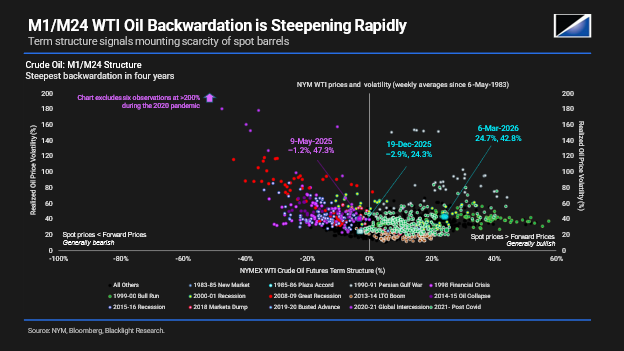
Filling storage and cutting production in the Middle East means oil stock draws in the rest of the world will now mount rapidly. All else equal, these draws will force cash oil prices higher, steepening backwardation in oil forward curves as consumers now compete more desperately for spot barrels.
This new phase already began on Friday. NYM WTI settled Friday at $90.90, up +$9.89 on the session (+12.2%) to cap a +35.6% weekly gain. This is the largest weekly move in this futures market’s history dating back to May 1983. ICE Brent closed at $92.69, +8.5% on the day and +28% on the week, for the biggest weekly advance since a bounce from near the COVID low in 2020.
Backwardation in the benchmark crude oil forward curves, as measured by the M1-M24 spreads, increased from 9.1% (Feb 27) to 40.3% (Mar 6) in WTI, 9.8% (Feb 27) to 33.3% (Mar 6) in Brent, and 9.2% (Feb 27) to 23.7% in Dubai.
Qatar's energy minister told the FT Friday that crude could hit $150/bbl within weeks if tankers remain locked out of the Strait. His assessment foots with our analysis of Friday’s trading in NYM crude oil options. By our calculations, they imply the upper end of the 95% confidence interval now sits just under $180 at the March 31 tenor and just under $200 at the June 30 tenor.
AAA reports the average U.S. pump price for regular grade gasoline was $3.45 per gallon as of Saturday (Mar 7), marking a gain of +47 cpg (+15.8%) since Feb 27. On Friday, wholesale cash prices for diesel reached $3.63 per gallon on the Buckeye pipeline and $3.53 per gallon on the Colonial pipeline. Those prices are now, respectively, +56% and +58% higher than a month ago.
Europe is getting hit harder: the region imports about 50% of its jet fuel through Hormuz. The spot price of jet fuel cargoes in Northwest Europe (CIF basis) jumped by more than +82% last week, from $831 to $1,517 per mt. Current price converts to the equivalent of $193 per barrel.
On Friday, CMX gold closed at $5,159 per oz, off its January high of $5,586 but well supported by safe-haven flows. CMX silver settled at $83.82 per oz. Both metals sold off modestly late in the week despite the war premium, partly on margin calls forcing liquidation across asset classes. We expect a bid in both gold and silver to pick up momentum again, but precious metals are now playing second fiddle to the oil complex.
Monday Mar 9 trading has already opened in Shanghai. The INE medium sour crude contract has leapt by 14%, in part catching up to Friday’s activity in London and New York. But we would note it is now fetching the equivalent of more than $109 per bbl.
At the Sunday night open for U.S. commodity futures in a few hours, WTI and oil products likely gap higher again. Every weekend headline has been escalatory: Tehran energy infrastructure targeted, Gulf production physically curtailed, Trump demanding unconditional surrender and floating ground troops, Iran's Assembly of Experts selecting a new supreme leader whose name has not been disclosed for his own protection. The Houthis have pledged to re-enter the fight.
None of these developments points toward de-escalation or Hormuz reopening within an imminent time frame. The question now is the magnitude of the consequences. A $3 to $5 gap higher for WTI is our base case tonight, though we expect Brent soon to cross $100, which will generate headlines.
Separately, market sentiment appears to be underestimating the permanence of forced shut-ins.
When any producer shuts in a well unexpectedly because storage is full, the well does not just turn back on at full rate. Forced closures under pressure cause damage that can permanently reduce recovery rates. The Society of Petroleum Engineers documented this pattern extensively after the 1991 Gulf War, when some Kuwaiti fields lost 15% or more of long-term production capacity.
Iraq, Kuwait, and soon potentially Saudi Arabia and the UAE are now shutting wells with the same forced haste and probably suboptimal mitigating protocols. U.S. Administration officials and investors seem to regard Hormuz as a temporary blockage, a valve that closes and reopens. But every day the strait stays shut, a portion of the supply that comes back online will be structurally smaller than what went offline. That delta is not in the curve yet.
This material is published by Blacklight Research, LLC (“Blacklight”) for informational, educational, and institutional research purposes only. All content has been compiled and presented as general market commentary and non-personalized research, without regard to the investment objectives, financial condition, risk tolerance, hedging needs, regulatory status, tax position, or other circumstances of any particular company, institution, fund, account, or individual. Nothing in this material is intended as, and nothing should be construed as, investment advice, trading advice, commodity trading advice, hedging advice, legal advice, tax advice, accounting advice, or any other form of individualized professional advice. This material is not an offer, solicitation, recommendation, endorsement, or invitation to buy, sell, subscribe for, hedge, or otherwise transact in any security, commodity, futures contract, option, swap, derivative, currency, index product, physical cargo, commercial contract, or other financial or commercial instrument. Any companies, securities, commodities, futures, options, swaps, contracts, indices, or strategies referenced herein are discussed solely for illustrative, analytical, or informational purposes. Blacklight is an independent publisher. Blacklight is not a broker-dealer, investment adviser, commodity trading advisor, commodity pool operator, futures commission merchant, introducing broker, swap dealer, or security-based swap dealer. Blacklight does not manage client assets, direct trading in securities or commodity interests, maintain discretionary authority over any account, execute or clear securities, futures, swaps, or other transactions, or provide individualized or customized investment, trading, hedging, or risk-management advice. Users are solely responsible for their own investment, trading, hedging, commercial, and risk-management decisions and actions, including any independent assessment of suitability, risk, liquidity, valuation, regulatory constraints, and legal obligations. Blacklight’s publications include macroeconomic analysis, commodity and market commentary, forward-looking assessments, geopolitical analysis, sector research, and other forms of substantive institutional research designed to assist clients in forming their own independent investment and commercial judgments. Blacklight’s publications may constitute research services that institutional clients may evaluate for eligibility under Section 28(e) of the Securities Exchange Act of 1934, subject to each client’s own good-faith determination and applicable law. Blacklight does not determine any client’s eligibility for Section 28(e) treatment and makes no representation that any client’s use of Blacklight research will qualify for such treatment. The information and opinions presented herein are based on data, market prices, company materials, government and regulatory publications, industry sources, news reports, third-party databases, proprietary data services, and other sources Blacklight deems to be reliable. Blacklight uses such sources in accordance with applicable license terms where relevant. Blacklight does not, however, make any representation, warranty, assurance, or guarantee, express or implied, as to the completeness, accuracy, timeliness, reliability, suitability, or availability of any information contained herein. Data may be incomplete, delayed, revised, restated, mis-transcribed, misinterpreted, or superseded. Any estimates, calculations, conversions, forecasts, scenarios, probabilities, and forward-looking assessments are based on assumptions that may prove incorrect and are subject to material uncertainty. The views expressed herein reflect Blacklight’s interpretations as of the date of publication and are subject to change without notice. All pricing, market data, and positioning data are as of the latest closing date prior to publication unless otherwise stated. Blacklight has no obligation to update, supplement, or revise this material after publication, or to notify any reader if any information, opinion, forecast, scenario, or assumption changes; however, Blacklight may, in its discretion, correct material errors that it identifies. Past performance is not necessarily indicative of future performance, and future results may differ materially from any historical performance, forecast, estimate, scenario, or projection discussed herein. Unless otherwise disclosed in the relevant publication, Blacklight and its principals, employees, contractors, or affiliates may hold positions in securities, commodities, futures, options, swaps, currencies, physical commodities, issuers, sectors, or instruments discussed, and such positions may change without notice. For this publication, Blacklight and the author(s) have disclosed any material financial conflicts they are aware of as of publication. No part of the compensation of any Blacklight analyst is determined by the specific views expressed in any publication or in any public or private meeting with clients. Trading, investing, hedging, or transacting in securities, commodities, futures, options, swaps, physical energy products, currencies, and related instruments involves substantial risk, including the possible loss of principal, liquidity risk, leverage risk, basis risk, volatility risk, counterparty risk, operational risk, regulatory risk, and the risk that market conditions change rapidly and unexpectedly. Commodity futures, options, swaps, and other derivatives may be unsuitable for many market participants and can involve losses exceeding initial margin or investment. Any discussion of hedging or risk management is general in nature and should not be interpreted as advice to implement or refrain from implementing any hedge, trade, or strategy. Any trade, shipment, financing, hedging, investment, commercial activity, or contractual arrangement involving affected regions, cargoes, vessels, counterparties, issuers, commodities, or instruments may be subject to sanctions, export controls, import controls, maritime law, market rules, exchange rules, position limits, anti-money-laundering rules, anti-corruption laws, and other legal or regulatory requirements. Readers are responsible for obtaining their own legal, regulatory, tax, accounting, compliance, and commercial advice before taking any action. This material may discuss war, terrorism, sanctions, geopolitical conflict, maritime incidents, physical infrastructure damage, or other events with serious human, security, and humanitarian consequences. Such discussion is included solely for the purpose of analyzing potential market, economic, commercial, and policy implications. Blacklight does not intend to minimize human suffering, endorse any political or military action, or attribute responsibility beyond the sources and analysis cited or described in the relevant publication. Blacklight is not liable for any loss, damage, cost, expense, or other consequence arising directly or indirectly from reliance on this material or any other content published by Blacklight. Blacklight’s research is published broadly and contemporaneously to clients and is not tailored to specific portfolio needs. Publications are distributed electronically by email and through website portals; delivery times may vary due to factors beyond Blacklight’s control. Blacklight does not provide client-specific versions of its publications, preferential access to unpublished research, or individualized follow-up advice tailored to any subscriber’s portfolio, trading book, hedging program, risk limits, tax position, or commercial exposure. This material is for the recipient’s personal or institutional internal use only and may not be copied, reproduced, modified, excerpted, distributed, redistributed, forwarded, posted, transmitted, or otherwise shared, in whole or in part, without Blacklight’s prior written consent. Cover art, charts, graphics, tables, photographs, and other visual materials are Blacklight intellectual property, generated materials, licensed content, public-domain content, or materials otherwise used in accordance with applicable law. All rights are reserved.