
The Djibouti Incident
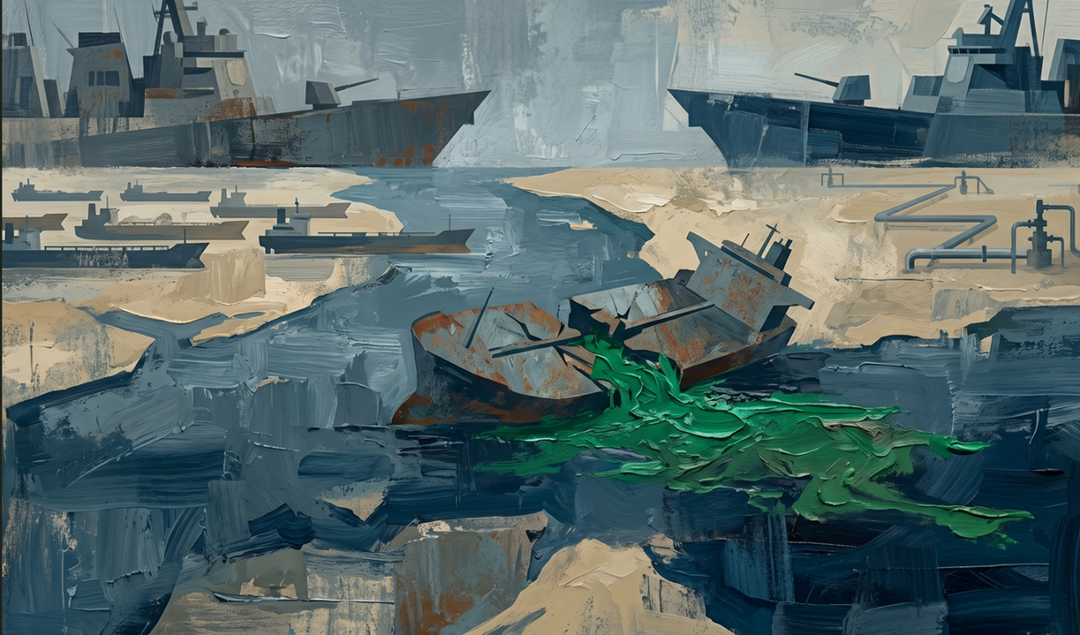
Afterlight is not a forecast. It is scenario analysis: a plausible narrative grounded in conditions that exist today, projected forward to illuminate what could happen. When multiple scenarios are published on a single subject, they are designed to be read together as descriptions of distinct, parallel universes that together provide one unified analysis of risk. This series, The Djibouti Incident, has three parts. We begin below with Part One: Two Chokepoints. The next two parts immediately follow. We conclude with our brief synthesis of what the scenarios teach us about risk and opportunity today.
The Fletcher School, Tufts University, Autumn 2035
The missile that sank the Huangyan Jade was fired from the coastal hills east of Mocha at 0347 local time on Monday, April 20, 2026. The weapon was an Asef, an Iranian Fateh-313 derivative with a 450-kilometer range and a 500-kilogram warhead, which the Houthis had paraded in Sanaa the year before and had never publicly used against a Chinese-flagged vessel. The Asef's electro-optical seeker acquired the Huangyan Jade fourteen kilometers northeast of Ras Siyyan, Djibouti, at the southern approach to the western channel of the Bab al-Mandab, and struck her amidships below the waterline on the port side. She had been loaded at Yanbu three days earlier with two million barrels of Arab Light that had been routed through the East-West Pipeline precisely to avoid the Strait of Hormuz. Bound for Quanzhou, the vessel carried a crew of twenty-six, all Chinese nationals. She went down in eleven minutes.
The context was crucial. The Huangyan Jade was a 307,000-deadweight-tonne VLCC operated by China Merchants Energy Shipping, a state-owned carrier whose vessels had been moving through the Bab al-Mandab without incident for the seven weeks since the 2026 Iran War began. Chinese-flagged tonnage had historically enjoyed a form of tacit immunity from Houthi attack, a courtesy extended in exchange for China's purchases of Iranian crude and its diplomatic cover for the Axis of Resistance.
Industry analysts later produced three competing theories for why the immunity collapsed on a Monday morning in April. The first held that the Houthis, operating under revised orders from Tehran after the Strait of Hormuz reopening fiasco of the previous Friday, had been told to strike any laden tanker bypassing the Strait, regardless of flag. The second held that the Huangyan Jade had been targeted in error, her identity masked by the kind of AIS spoofing that had become routine in the Gulf. The third held that the attack was a deliberate political signal from a Houthi command that had come to resent Chinese free-riding on Iranian sacrifice. No single theory was proven. The Huangyan Jade was, in any case, gone.
The positioning of her sinking would shape everything that followed. The Bab al-Mandab is twenty-six kilometers wide at its narrowest point, bisected by Perim Island into two channels: the eastern Bab Iskender, three kilometers across and thirty meters deep, used only for local traffic; and the western Dact-el-Mayun, twenty kilometers across and over three hundred meters deep, through which international shipping moves. The Huangyan Jade went down in the western channel, within the internationally designated transit corridor, in water too deep to obstruct navigation by hull contact alone. Her wreck did not seal the strait. But a VLCC carrying two million barrels of crude does not sink politely. The oil slick began spreading within the hour, driven by the inward surface current toward the Djiboutian coastline. The debris field, including a 140-meter section of bow that did not initially sink, drifted into the primary transit lane. The salvage assessment, when it came four days later, identified submerged bunker fuel tanks and unignited cargo residue as navigation hazards of indeterminate duration. And the insurance market did what insurance markets do when a single event destroys twenty-six crew members, two million barrels of cargo, three hundred million dollars of hull, and the assumption that any Red Sea transit was safer than the Strait of Hormuz. It stopped underwriting.
This was the second of two chokepoints. The first had already closed, again. Two days earlier, on the evening of Saturday April 18, the IRGC had reversed the foreign minister's Friday announcement of reopened Hormuz transit and fired on two Indian-flagged vessels, including the VLCC Sanmar Herald, in a demonstration that the Strait remained under Iranian military control regardless of what diplomats in Tehran or Washington claimed. The Friday rally that had taken the S&P 500 to a third consecutive record high and cut Brent crude eleven percent to $90.38 had been a speculation on peace. By Saturday evening the speculation had been refuted. By Monday morning the Huangyan Jade had sunk. The commercial assumption that Yanbu loading plus Bab al-Mandab transit provided a functional bypass of Hormuz was shaken.
The response in Beijing was immediate and, in a way that no Western analyst had modeled, symbolic. The Chinese name of the sunken vessel, Huangyan, was the Chinese name for Scarborough Shoal, the disputed feature in the South China Sea where Beijing had installed a floating barrier ten days earlier as part of its maritime pressure campaign against Manila. The naming was commercial coincidence (CMES had operated vessels with the Huangyan prefix for over a decade) but the symbolism was not lost on the Central Military Commission. At 0900 Beijing time on April 20, approximately six hours after the sinking, the PLA Navy announced that the 48th Escort Task Force, already stationed at the Chinese Support Base in Djibouti, would be reinforced by the Liaoning carrier strike group and additional surface combatants drawn from the Northern Theater Fleet. At 1400 Beijing time the Foreign Ministry spokesperson delivered a statement in Mandarin, then repeated it in English. The phrase that mattered was baohu zhongguo gongmin de shengming: "protection of the lives of Chinese citizens." The phrase had been used once before in this context, during the 2015 evacuation from Yemen. The subsequent usage in April 2026 was understood in Washington, correctly, as a declaration that China now considered itself a party to the conflict.
Brent crude opened in the Sunday evening session trading above $108, up from $90.38 at the Friday close, and by the time European markets opened Monday morning was at $118. WTI followed at $121. The physical Dubai and Oman sour benchmarks, which had been compressed toward Brent parity during the Friday rally, reopened the gap violently. Oman cash crude surged to $178 per barrel by Monday afternoon, a level that implied rapidly depleting sour barrels for Asian refiners. The S&P 500, which had closed Friday at a record 7,142, fell 4.8 percent Monday and another 3.1 percent Tuesday. The VIX thereafter reached 65, its highest value since the COVID spike of March 2020. Gold, which had been in a grinding decline through April as margin calls forced rotation out of precious metals into energy hedges, reversed sharply and crossed $5,100 by Wednesday. The U.S. Dollar Index (DXY) strengthened by 2.3 percent within days as capital fled to U.S. Treasury securities despite the inflationary implications of the oil shock. The ten-year U.S. Treasury yield, which had shed six basis points to close at 4.25% during the peace speculation on the Friday before the Djibouti Incident, quickly slumped below 4.0% as growth fears simultaneously competed with inflation fears amidst conditions of confusion and uncertainty.
This combination of rising oil, rising gold, rising dollar, and falling yields was the financial signature of a shock that the market had not priced and could not yet metabolize. It had last been observed in September 2008.
The Saudi response was the one piece of the architecture that briefly held. Aramco's East-West Pipeline had been running at its full seven-million-barrel capacity since March 11, feeding Yanbu with crude rerouted from the Persian Gulf fields. On Monday evening, as the scale of the Bab al-Mandab closure became clear, Aramco began reducing pipeline throughput for the first time since the war began. The reduction was not voluntary. Yanbu's loading terminals, which had been operating above their tested four-million-barrel-per-day capacity for seven weeks, could not load cargoes that had no insured transit lane to take them away. The port's onshore storage, which the kingdom had expanded emergency style through March, began backing up. By Friday April 24, Aramco had cut pipeline flow to 4.2 million barrels per day and was running the Abqaiq processing complex at reduced rates. The kingdom had solved its Hormuz problem by building the East-West Pipeline in 1981. It now discovered that Hormuz and Bab al-Mandab had, in forty-five years, become a single problem.
The effect on Saudi production, within ten days, was an involuntary shut-in of approximately 1.8 million barrels per day from the eastern fields. Aramco's CEO Amin Nasser, who had become the administration's unofficial interlocutor with the White House during the war, briefed the president on April 28 that without a credible reopening of either strait within thirty days, sustained shut-ins would cause reservoir damage at several of the Ghawar satellites. The damage would be recoverable but would reduce the kingdom's peak production capacity for two to three years after normalization. Nasser did not offer a solution. He offered a calendar.
The calendar was not, in the event, respected. The diplomacy that might have respected it had been damaged beyond repair by the events of the previous week. The Iranian foreign minister Abbas Araghchi, who had declared the Strait of Hormuz open on Friday and had been publicly contradicted by his own parliament speaker on the same day, was politically destroyed. He resigned on Tuesday April 21 and was replaced by a more senior IRGC-aligned figure whose appointment ended the possibility of bilateral dialogue with Washington through any channel short of Pakistan's army chief Asim Munir, who was himself recovering from the Islamabad Talks collapse of the previous week. The Omani channel, which had been the reliable back-door of the entire war, remained open but was now carrying only technical communications. The substantive political negotiation had moved to a channel that did not exist.
The American response compounded the damage. On Monday April 20, with the Huangyan Jade newly sunk and the Chinese fleet announcement still being digested, President Trump convened a morning meeting in the Roosevelt Room that participants later described as the angriest of his administration. The transcript, reconstructed from staff notes later disclosed in the Congressional hearings on the matter, records the president asking, repeatedly, why a Chinese ship carrying Saudi oil to a Chinese refinery was his problem. The question, viewed from 2035, contained its own answer.
But in the room on April 20 the president's instinct was to respond to a Houthi attack on Chinese tonnage with an expansion of the American blockade of Iranian ports. Secretary Hegseth pushed back. Vice President Vance pushed back harder, arguing, correctly, that an expanded blockade would be interpreted in Beijing as a deliberate squeeze on Chinese energy security during an active PLA deployment. The president, in a decision that Vance would describe to the Djibouti Commission panel in 2027 as "the moment we lost the option of de-escalation," ordered the blockade expanded to include interdiction and boarding of any tanker departing from or arriving at an Iranian-controlled facility, regardless of flag state or ultimate destination. The order was transmitted to CENTCOM at 1437 Eastern on Monday April 20. By Tuesday evening, two Chinese-flagged vessels had been turned back from Kharg Island under U.S. naval escort.
Beijing's response did not arrive through diplomatic channels. It arrived on Wednesday April 22 as a coordinated action across three theaters. In the South China Sea, the Scarborough Shoal barrier was expanded and PLAN naval vessels conducted what Xinhua described as "routine verification exercises" within fifty nautical miles of the Philippine coast. In the East China Sea, a formation of Chinese J-16 fighters conducted the deepest penetration of Japan's Air Defense Identification Zone on record. And in the Red Sea, the 48th Escort Task Force moved from its station at the Chinese Djibouti base into the Bab al-Mandab itself, taking up position approximately fifteen nautical miles from the Huangyan Jade wreck and announcing that it would escort any Chinese-flagged commercial vessel through the strait and, further, that it would require prior notification from non-Chinese naval vessels transiting the area. The claim of authority was not recognized in international law. It was also not contested, because the only naval forces in position to contest it were the French at their Djibouti base, who declined, and the American CENTCOM assets, whose commander requested rules of engagement clarification from Washington. The clarification took four days. By then, Chinese escorts were routine.
This was the moment at which the Iran War, which had been a regional conflict with global energy consequences, became a great-power confrontation with regional energy consequences. The reversal in emphasis mattered. A regional war, even a severe one, had been priceable in a conventional framework: oil prices rise, central banks hold steady, fiscal authorities absorb the shock, and recovery follows the military resolution. A great-power confrontation with no clear military resolution had no historical precedent in the post-1945 pricing regime. The shock was not being resolved. It was being restructured.
The restructuring took shape in three dimensions over the six weeks that followed. The first was commercial: the systematic redirection of Gulf crude away from Hormuz and Bab al-Mandab and around the Cape of Good Hope. Through March, Cape routing had been a marginal flow of perhaps two million barrels per day of Saudi and Iraqi crude moving via the longer journey around southern Africa. By mid-May the flow was seven million barrels per day. For cargoes already loaded at Yanbu, the operational sequence was awkward: northbound through the Suez Canal after partial discharge into the Sumed pipeline to meet Suezmax draft limits, topping off again in the Mediterranean, then circumnavigating Africa to reach Asian buyers.
The resulting Yanbu-to-Yokohama voyage ran approximately 16,500 nautical miles and took thirty-six days at economic speed, against 6,600 miles and twenty days on the direct pre-war Persian Gulf route. The Arabian Gulf–to–Asia voyage via the Cape, when the origin was a Gulf port rather than Yanbu, ran closer to 14,500 miles and thirty-two days. Tanker freight rates, which had been elevated through March at roughly $12 million per VLCC voyage on the Yanbu-to-Asia route, now rose to $28 million on the full Cape route. The shipping cost of every barrel of Gulf crude moving to Asia rose by roughly $5 to $6 per barrel, a new structural cost that flowed directly into refined product prices at the pump in Ulsan, Yokohama, and Singapore.
The second dimension was naval. The Chinese deployment to Bab al-Mandab was followed within two weeks by an Indian carrier group at the western Indian Ocean, a French frigate reinforcement at Djibouti, an Italian deployment under EU Operation Aspides, and a Russian naval detachment that transited the Bosphorus over Turkish objections and took up position in the Red Sea in what Moscow described as a "humanitarian support mission." The Gulf of Aden and southern Red Sea, which had been patrolled by the US-led Combined Maritime Forces since 2002, were now contested waters with five distinct naval commands operating in close proximity without unified deconfliction. The first serious incident occurred on May 14, when an Indian Shivalik-class frigate and a Chinese Type 054A maneuvered at high speed within 200 meters of each other in the western channel. No shots were fired. A near-collision was averted by the Chinese vessel, which turned first. Indian and Chinese military commentators would, for the rest of 2026, debate what had actually happened. This was, historians later concluded, the closest the two nuclear powers came to a shooting incident since 1967.
The third dimension was financial, and it was the factor through which the shock did most of its damage. The commodity trade finance system, which had held through the seven weeks of the Strait of Hormuz closure because Yanbu continued to load and the Cape route remained functional, now confronted an event it had not been designed for. The Huangyan Jade claim, at approximately $380 million for hull and cargo combined, was among the single largest marine insurance claims in the history of the industry. It was paid. But the reinsurance market that sat behind the primary underwriters then began to reprice every Red Sea and Gulf of Aden transit at rates that no commercial shipper could absorb. War-risk premiums for Bab al-Mandab transits rose from the pre-war baseline of 0.125 percent of hull value to 8.5 percent by late May. On a typical VLCC, this translated to an additional $25 million per voyage in insurance cost alone (or about +$12 per bbl). The Cape route's war-risk premium settled at a lower 1.2 percent, reflecting the reduced threat environment, but imposed its own costs through the extended voyage duration and the concentration of global tanker tonnage on a single route.
The commodity trading houses absorbed the initial shock. By the third week of May, they were failing to absorb it. The first default was Tendplus Group S.A., the Geneva-based mid-tier trader whose name had become associated with the earlier trade-finance stress episode of March 2026. Tendplus had, correctly, not extended its forward commitments beyond what its revolving credit facility and its hedging discipline could support. What it had not anticipated was that a functioning Bab al-Mandab transit lane was the implicit precondition for its entire April-June delivery book. On May 26, Tendplus declared force majeure on sixteen cargoes representing approximately $1.4 billion in contracted volume. The declaration was refused by four of its counterparties, who argued, correctly on strict legal grounds, that the Cape route remained available and that the company's obligation to deliver was not extinguished by elevated costs. Tendplus filed for bankruptcy protection in Geneva on June 2. The collapse of Tendplus was followed within ten days by the distress of a Singapore-based trader whose books had not been as disciplined. The two failures, taken together, began to propagate through the European commodity trade finance banks in the way that the 2015 Noble Group crisis had propagated but with roughly five times the dollar magnitude.
The contagion reached the major banks on June 15, when a French bank with a significant commodity trade finance book disclosed emergency provisioning of 2.8 billion euros. Its stock fell 34 percent in four sessions. A Dutch bank followed on June 20 with a similar announcement. The European Central Bank, in a coordinated statement with the Swiss National Bank on June 22, provided emergency dollar liquidity to the affected banks. The ECB action stabilized the primary banking exposures. It did not stabilize the underlying commodity trade, which continued to migrate onto the Cape route and continued to pay its new tax.
By the end of the second quarter of 2026, the physical oil market had found a new equilibrium. It was not a comfortable equilibrium. Global crude flows were running roughly 3.5 million barrels per day below the pre-war baseline, the bulk of the shortfall concentrated in Asian refining. SK Innovation's Ulsan complex, which had operated at 65 percent through March and April using Yanbu-sourced crude, fell to 52 percent in June as Yanbu loadings declined with the backed-up pipeline. Reliance's Jamnagar ran at 73 percent. The Japanese refiners Idemitsu and Cosmo announced coordinated run cuts, the first such coordination since the 1973 shock. In Europe, the combination of the sustained Ras Laffan force majeure and the delayed Yanbu deliveries produced a gasoline and diesel tightness that the continent had not experienced since the Ukrainian war's first winter. European TTF natural gas, which had traded at €52 per megawatt-hour during March, reached €78 in June as replacement LNG was sourced from the US Gulf Coast at premium rates and European storage refill fell critically behind schedule.
In the United States, the political economy of the shock took a form the administration had not anticipated. American energy production, which the administration had spent the first half of the war celebrating as the structural response to Gulf disruption, reached its operational ceiling in May and could not grow further on any reasonable timescale. US crude exports ran at 5.8 million barrels per day through the quarter, roughly the maximum terminal capacity of the Gulf Coast export infrastructure. Every incremental barrel that could be produced was being produced, and every barrel that could be exported was being exported. The market's expectation that US shale could ramp an additional two million barrels per day into the shock was disappointed by the reality that completion crews, frac sand logistics, and pipeline takeaway had been optimized through five years of capital discipline for a specific throughput. Ramping above that throughput was a multi-year project, not a multi-month one. The industry's public communications on this point were unusually candid. Convex Resources' CEO described the ceiling in congressional testimony on June 3 with a phrase that became the quarter's most-quoted line: "You cannot sprint the last mile of a marathon."
Gasoline prices crossed $6.00 per gallon on May 18 and did not fall below $5.50 for the rest of the quarter. Diesel reached $7.20. The airlines, which had hedged a fraction of their 2Q2026 consumption at sub-$85 Brent during the brief Friday April 17 euphoria, absorbed unhedged fuel costs that reduced aggregate US airline EBITDA by an estimated $18 billion for the quarter. Delta and United announced coordinated capacity reductions of 12 percent beginning in July. U.S. consumer confidence, which had rebounded briefly on the promise of Hormuz reopening, collapsed from 48 in April to 40 by the end of June, a new all-time low in the series.
The Federal Reserve, meeting on June 17 and with Kevin Warsh as its newly installed Chairman, faced the same problem it had faced in every meeting since March: inflation was accelerating while growth was decelerating. Chair Warsh's post-meeting statement included a sentence that would be scrutinized for years: "The committee judges that the risks to the employment mandate have risen substantially and now balance the risks to the price stability mandate." The translation, which markets performed within minutes, was that the Fed was considering a cut. The ten-year Treasury yield fell 42 basis points on the statement. The dollar fell 1.8 percent. Gold rallied to $5,680.
The decision to cut, which came at the July 29 meeting, was the moment that the defenders of Fed independence identified as the institution's capitulation to the political pressure of a collapsing economy, and that the defenders of Fed pragmatism identified as the correct response to an emergent unemployment problem that the inflation framework could not address. Both characterizations were, to some extent, correct. The cut, of 50 basis points to 3.75 percent, did not materially alter the inflation path. It did not reopen the Bab al-Mandab. It did not restore commercial trade finance. It did signal, to the credit markets and to the commodity trading houses, that the monetary authority had judged the downside risks greater than the inflation risks, and that subsequent cuts would follow. By year-end the federal funds rate was 2.75 percent, with Brent crude still in the mid-$90s and CPI still running at 5.4 percent year-over-year.
The midterm elections of November 2026 were held against this backdrop. The incumbent party lost forty-seven seats in the House and control of the Senate by a two-seat margin. The exit polling identified gasoline prices, utility prices, and airline costs as the dominant economic concerns, but the most significant finding was a collapse in the share of voters who identified the president's handling of the Iran war favorably. In the first week of the war, that share had been 44 percent according to a Marist poll. By November, it was 28 percent. The gap was among the largest adverse swings on a single policy dimension in the history of the exit polling series.
The collapse was not caused by any single decision. It was caused by the accumulated weight of a conflict that had been launched on the premise of a four-to-six-week campaign and had, by the midterms, extended into its ninth month with no clear resolution, a closed Strait, a closed Bab al-Mandab, a Chinese fleet permanently deployed to the Red Sea, a trade-finance system under continuing stress, and consumer prices that had not returned to pre-war levels for any category of fuel, food, or transportation. The war had not ended. While it had achieved its nominal military objectives (Iran's nuclear program destroyed, its senior leadership killed or in hiding, its proxy capacity degraded), it had continued because no framework existed for ending it. The ceasefire announced on April 8, which had expired on April 21, had been followed by a second ceasefire in August and a third in November, each of which held in Tehran and failed in the Bab al-Mandab. The Houthis continued to attack shipping. Iran continued to close the Strait at moments of its own choosing. China continued to escort its own tonnage through the Red Sea. The United States continued to blockade Iranian ports. None of these postures was inconsistent with a formal ceasefire. All of them made the global commodity trade fifteen percent more expensive than it had been in February.
The Strait of Hormuz physical reopening began in January 2027 after a Chinese-brokered agreement that the administration described as "constructive" and that the Iranian foreign ministry described as "a new beginning for Asian energy cooperation." The English translations were honest. The Chinese text, which was the operative text, made reference to a "new framework of multipolar maritime security" that implicitly acknowledged a Chinese guarantor role in the Indian Ocean and Red Sea that Beijing had declined to claim publicly for the previous eight months. The Bab al-Mandab war-risk premium fell from 8.5 percent to 2.1 percent on the agreement's announcement. The Cape routing flow declined from seven million barrels per day to three million over the following quarter. By mid-2027 the physical oil market had substantially normalized, though the insurance premium for Red Sea transits never returned below one percent and the ship-finance architecture that had rebuilt itself around the Cape route persisted in modified form for the rest of the decade.
The structural changes were of a different order. The US dollar's share of global reserves, which had been 58 percent in February 2026, was 54.3 percent by the end of 2027 and 52.1 percent by the end of 2029. The decline was not a collapse. It was, as the Congressional Budget Office analysis of 2028 described it, "a sustained and apparently secular erosion." The renminbi's share, which had been 2.8 percent in February 2026, was 6.4 percent by the end of 2029. The gap was filled primarily by gold, whose share of global official reserves rose from 16 percent to 23 percent over the same period, and secondarily by the euro and a basket of smaller currencies including the Indian rupee and the Brazilian real. The Chinese-Saudi renminbi oil settlement framework, which had been a 2024 pilot program, expanded in 2027 to cover 35 percent of Saudi crude sales to China, a figure that represented roughly $120 billion annually and that generated commensurate renminbi demand in international markets. The parallel Indian-Saudi rupee framework, which had been a 2026 emergency measure, was formalized in 2028 at approximately $40 billion annually.
The S&P 500, which had closed at 7,142 on April 17, 2026, did not return to that level until December 2028. The index's composition at that point, as in the most severe of the Iran-war scenarios, was substantially altered. The weight of energy and defense had doubled. The weight of consumer discretionary had halved. The AI infrastructure names that had led the market in 2024 and 2025 had bifurcated into a winners' cohort (the hyperscalers with demonstrable productivity applications) and a losers' cohort (software developers and the infrastructure buildout names whose economics had been disrupted by the elevated cost of capital and the Chinese export restrictions on rare earth processing that had followed Beijing's shift to strategic competition with the United States). Nvidia had recovered from its 2026 lows, which had bottomed at $62, but its 2029 valuation multiple was compressed to levels that implied a mature semiconductor business rather than an exponential growth story.
Gold, having crossed $5,100 in the week of the Djibouti Incident, continued its ascent through 2027 and 2028. The metal crossed $8,000 in March 2028 and $10,000 in October 2029, a trajectory that had been predicted by a small number of commodity analysts for several years but that had required the specific combination of a closed Hormuz, a closed Bab al-Mandab, a Chinese naval presence in the Indian Ocean, and a serial restructuring of global reserve currency composition to actually materialize. Central bank purchases from non-Western nations, which had been the dominant structural bid for gold since 2022, continued at elevated rates through the decade. The metal was no longer being priced as a hedge against inflation or as a safe haven against market volatility. It was being priced as an alternative reserve asset by nations that had concluded the dollar-based monetary system was no longer politically neutral.
Copper boomed. The metal reached $18,000 per tonne in 2028 as grid reconstruction, electrification of Chinese and Indian transport, and the continued buildout of data-center power infrastructure overwhelmed a supply side that the 2020-2025 underinvestment cycle had left catastrophically unprepared. The LME cash price crossed $22,000 in 2029. By 2030, the world's largest copper miners were returning capital to shareholders at rates that exceeded the cash flows of the Saudi national oil company during the peak of the 1974 oil shock. The electrification thesis was vindicated not by the rapid adoption of electric vehicles or by the gentle global energy transition but by the violent revelation that the physical infrastructure of civilization required more copper than the global mining industry could produce, and that this requirement became urgent the moment anyone attempted to electrify anything at scale while simultaneously rebuilding their strategic autonomy in response to broken security guarantees.
From the vantage of 2035, the aftermath of the Djibouti Incident is not the worst outcome that could have issued from April 2026. The worst outcome would have been an armed clash between the Chinese and American naval forces in the Bab al-Mandab, which came close on several documented occasions in 2026 and 2027 but did not materialize. The worst outcome within the economic frame would have been a sustained cascade of bank failures beyond the two European institutions that required ECB liquidity support, which also did not materialize. The Iran War was not as catastrophic as it might have been in a parallel universe. Nonetheless, it was expensive, structural, and transformative of the post-1945 security and monetary architecture in ways that the architects of Operation Epic Fury had not contemplated when they ordered its execution fifty-one days earlier.
The Huangyan Jade wreck remained in the western channel of the Bab al-Mandab throughout 2026 and 2027. The salvage operation, which had been delayed by the Chinese naval presence, the contested territorial waters, and the insurance disputes, did not begin until June 2028. The wreck was eventually raised and scrapped at Alang. The oil that had not burned or evaporated in the weeks after the sinking was recovered by a Japanese salvage consortium operating under Djiboutian license with Chinese security cover. The twenty-six crew members were, in the final accounting, recovered over a period of four months. Their families received compensation from a joint CMES-Iranian fund that had been established in a confidential protocol of the January 2027 Chinese-brokered agreement. The protocol was not published. Its existence was confirmed by the Chinese foreign ministry in 2029.
The hardest lesson of the Djibouti Incident, which was absorbed unevenly across the surviving institutions of the American-led order, was that global energy security reliant on two waterway chokepoints with a single naval guarantor had been obsolete for some time before April 2026 and had, on that Monday morning, simply revealed the reality of the obsolescence. Hormuz alone could be closed. Bab al-Mandab alone could be closed. Together, they could not be kept open by any naval force that any Western coalition was prepared to commit to the task. The Chinese understood this before the Americans did. The Americans understood it by the autumn of 2026. The rest of the world, which had been assured that the American naval protection would always be the concrete foundation of global commerce, absorbed the lesson through the price of gasoline and the cost of rice and the difficulty of obtaining a letter of credit for a shipment of Saudi crude to a Korean refinery in the summer of a year when the American and Chinese navies had both been deployed to protect commercial traffic that neither could actually protect.
The lesson did not fit in any framework that the market had previously used to price geopolitical risk. It required a new framework, which the market assembled over the subsequent three years through the painful process of repricing every asset that had implicitly been valued against the assumption of American naval primacy. The repricing was not complete by 2030. It was not complete by 2035. It remains, at the time of this writing, an ongoing adjustment of expectations to a reality that had been established, suddenly and without negotiation, on a Monday morning in April 2026 when a Chinese tanker carrying Saudi oil to a Chinese refinery was sunk by an Iranian missile fired by Yemeni hands fourteen kilometers off the coast of a country that hosted the naval bases of every major power and, in the end, could protect the commerce of none of them.
That is what chokepoints can do. They stay relaxed for years then constrict and reveal the true nature of geographic risk in an instant. The lesson was older than anyone had remembered, and more fragile than anyone had priced.
This Afterlight series on The Djibouti Incident has three parts. This is Part Two: The Long Detour.
The Fletcher School, Tufts University, Autumn 2035
The response to the sinking of the Huangyan Jade was, in the end, more modest than either its opening hours or its closing consequences suggested.
This is a difficult thing to convey. The events of the week beginning Monday, April 20, 2026 contained every element of a great-power confrontation. A Chinese-flagged VLCC carrying Saudi oil had been sunk by an Iranian-supplied missile fired by a Yemeni proxy in waters that hosted American, French, Chinese, and Japanese military bases. The Chinese response included a carrier strike group deployment, a Beijing statement invoking the protection of Chinese citizens abroad, and a naval escort regime in the Bab al-Mandab that was not recognized in international law. The American response included an expanded blockade of Iranian ports that turned back Chinese-flagged tanker traffic. The Saudi response was to shut in over a million barrels per day of eastern field production within the first two weeks. Every piece of machinery for a catastrophic outcome was in motion.
The machinery did not, in the event, produce a catastrophic outcome. The Djibouti Incident became, instead, the specific pressure point that forced the actors to find their workarounds. It was painful. It was expensive. It was structural. But it was not, in the technical sense that economic historians use the word, a rupture.
Understanding why requires understanding three factors the consensus narrative of April 2026 missed.
The first factor was the trajectory of the Cape route. For a VLCC already loaded at Yanbu, the eastbound voyage to Yokohama required partial discharge into the Sumed pipeline to meet Suezmax draft limits, a northbound transit of the Suez Canal with the attendant toll, a topping-off lift in the Mediterranean, and then the long circumnavigation of Africa: approximately 16,500 nautical miles, thirty-six days at economic speed, against 6,600 miles and twenty days on the pre-war Persian Gulf route. The direct Persian Gulf–to–Asia voyage via the Cape, when the origin was a Gulf port rather than Yanbu, ran closer to 14,500 miles and thirty-two days.
The extended duration meant that every commercial cargo in transit carried fifteen or more additional days of storage risk, extra crew pay, and capital tied up in working stock. These costs, absorbed into the delivered price of crude at the Asian refinery gate, added roughly eight dollars per barrel of structural cost to the trade. This was not, viewed against a starting Brent price of $90, a catastrophic increment. It was, to put the point precisely, roughly the same tax that the Ukraine war had imposed on European gas supply for the three years prior. The world had learned, in those three years, that eight dollars per barrel of geopolitical friction on a major commodity trade was absorbable. Painful, regressively borne by lower-income consumers, politically consequential, but absorbable. The Bab al-Mandab closure imposed a friction of this magnitude. It did not impose a friction that exceeded the absorptive capacity of the global economy.
The second factor was the structure of Chinese strategic calculation. The Beijing response to the Huangyan Jade had included the carrier deployment, the escort regime, and the rhetorical commitment to protect Chinese citizens abroad. It had not included the one action that would have produced a kinetic confrontation: a direct military response against Houthi targets in Yemen, or a demand that the United States cease blockade operations against Iranian ports. The Chinese were, in this account, managing their domestic politics and their international posture simultaneously. Domestic audiences were shown a PLA Navy protecting Chinese commercial vessels. International audiences were shown a Chinese naval power credible enough to escort but not so aggressive as to require American response. The Western analysts who interpreted the deployment as a prelude to confrontation had misread the signal. The deployment was a prelude to stabilization under Chinese-negotiated terms, and the Chinese were prepared to wait several months for those terms to become acceptable to Washington.
The third factor was the adaptive capacity of the commodity trade finance system, which turned out to be greater than the worst-case analyses had projected. The system had been designed over decades to handle a wide variety of shocks: piracy, regional wars, hurricane disruption, terminal damage, occasional sovereign defaults. It had not been designed to handle a complete closure of two major waterway chokepoints simultaneously. But it had enough redundancy, enough optionality, and enough institutional memory to reroute around the closure without collapse. The Cape routing was the obvious adaptation. The less obvious adaptations were the ones that mattered more: the reactivation of dormant storage capacity in South Africa and East Africa, the expansion of ship-to-ship transfer operations off Durban and Lagos, the emergence of an Indian Ocean spot market for crude that had previously been a term-contract trade, and the quiet Chinese facilitation of insurance coverage through Chinese state-owned reinsurers for any Chinese-flagged vessel willing to take the Cape route.
The last point mattered most of all. The Chinese reinsurance expansion, announced on April 28 and operational by May 10, provided war-risk coverage for Chinese-flagged tonnage at rates substantially below the Lloyd's market. The Chinese state, in effect, subsidized the Cape route for its own commercial fleet. The subsidy was not economically rational in conventional terms. It was strategically rational: it ensured that Chinese refiners could continue to receive Gulf crude at costs that did not spike to crisis levels, which preserved the Chinese economy's performance through the acute phase of the shock, which preserved Beijing's political latitude to negotiate a longer-term settlement with Washington on terms that did not require immediate concession. The Chinese were buying time, and they were buying it at a cost that their sovereign balance sheet could absorb but that no commercial balance sheet could have justified.
The American response, which had opened with the confrontational blockade expansion of April 20, moderated over the following six weeks. The moderation was not ideological. It was operational. The CENTCOM commander's request for rules-of-engagement clarification on April 22, which had initially been interpreted in Washington as bureaucratic obstruction, was in fact the beginning of the military establishment's quiet redirection of presidential policy back toward the achievable. By early May, the CENTCOM operational posture had evolved. Chinese-flagged vessels departing Iranian ports were logged but not interdicted. The blockade remained rhetorically intact while being operationally reduced to the narrower posture it had occupied before April 20. This was not a public reversal. It was a bureaucratic sclerotic response to a political order that the career military had assessed as likely to produce outcomes the administration did not actually want. The assessment, viewed from 2035, was substantially correct. The political order was not formally rescinded until August.
Following the Djibouti Incident, Saudi oil supply movements tightened through the end of April as pipeline flow reduced and production shut-ins accelerated. They then stabilized in May through an arrangement that the Saudi foreign minister would later describe as "the Kingdom doing what the Kingdom has always done: exporting oil through whatever routes remain available."
The phrase was diplomatic understatement. In practice, the Kingdom executed three simultaneous operational responses. First, it accelerated the Yanbu-to-Cape routing for its eastern field production, accepting the voyage extension and passing the cost through to customers who, given the alternative of no delivery, accepted the price increase.
Second, it expanded the East-West Pipeline's emergency throughput beyond the seven-million-barrel capacity that had been understood as its ceiling, a feat achieved through a combination of reduced delivery pressure, temporary bypass of several booster stations, and acceptance of accelerated wear on the pipeline infrastructure that would require maintenance downtime in 2027.
Third, and most consequentially, it reached a quiet commercial accommodation with Iran that allowed limited resumption of Saudi oil movement through Hormuz under Iranian escort, at a toll of approximately two million dollars per VLCC transit, paid through intermediary accounts in Qatar and Oman. The accommodation was not publicly announced. It was not approved by Washington. It was, in the subsequent months, the mechanism that prevented the physical production shut-ins from reaching the threshold that would have damaged the Ghawar reservoir satellites. Aramco's CEO Amin Nasser, who had briefed the White House on April 28 about the reservoir risk, did not mention on that occasion the accommodation that his government was simultaneously negotiating. He was, in the characteristic elliptical manner of senior Saudi officials, giving the president the warning that would make the accommodation inevitable while preserving the president's deniability about its existence.
The accommodation was the single most important commercial detail of the scenario. It ensured that Saudi production never shut in sufficient volume to produce the reservoir damage that Nasser had warned about. It ensured that Gulf crude continued to reach Asian markets, via a combination of direct Hormuz transit at Iranian-imposed cost and Cape routing at extended cost. It ensured that the physical oil market, while expensive, remained functional. The accommodation was one of the hundreds of accommodations that the Middle Eastern commodity trade had, over decades, perfected the art of negotiating without publicizing. It was, in its own quiet way, the lever that prevented a painful outcome from becoming a catastrophic one.
Brent crude traded in a range between $105 and $125 through the second and third quarters of 2026, elevated but not spiraling. The Dubai and Oman physical benchmarks maintained a sustained premium of $12 to $18 per barrel over Brent, reflecting the continued insurance and routing friction, but did not exhibit the $40-plus dislocations that would have indicated imminent system failure. Gold reached $5,400 in the immediate aftermath of the Djibouti Incident and settled into a range of $5,000 to $5,500 through the rest of the year. The S&P 500 fell 12 percent from its April 17 peak to its mid-May trough, a correction rather than a bear market in the technical vocabulary of the time, and recovered to within 5 percent of its peak by year-end.
The recovery was not indiscriminate. It was a rotation. The sectors that had led the pre-incident market (the hyperscalers, the AI infrastructure names, the consumer discretionary franchises) lagged through the summer and fall. The sectors that led the recovery were energy infrastructure, defense primes, insurance, and the specific logistics companies that had pivoted fastest to Cape routing. The rotation was the defining equity story of 2026. It was also the story that institutional portfolio managers had been positioned for since March, based on the physical-market signals that a small number of independent research firms had been spotlighting through the spring.
The Federal Reserve, which had held steady through the March and April meetings, held steady through May and June as well. The July meeting produced the first cut, a quarter-point reduction that Chairman Warsh described as "a reasonable insurance measure against downside risks to the employment mandate." The cut was smaller than the easing that would have occurred in the more severe scenario, and was accompanied by explicit language committing to a higher terminal rate. The Fed's framework, which had been under considerable pressure through the acute phase of the shock, held because the shock moderated before the framework had to be formally revised. This was, arguably, the single most important macro outcome of the period: the preservation of monetary policy credibility through a crisis that had contained all the elements for credibility destruction but had, in the end, resolved before the destruction occurred.
The U.S. dollar did not experience the structural erosion that some feared. It depreciated modestly against the basket, approximately 4 percent on a trade-weighted basis through the second half of 2026, and recovered half of that depreciation during the 2027 normalization. The renminbi's share of global reserves rose, but by less than a percentage point. The Saudi-Chinese settlement framework expanded modestly, covering an additional 7 percent of Saudi crude exports to China by 2028, bringing the cumulative renminbi-denominated portion to 18 percent. In other words, significant but not transformative. Gold continued to benefit from the non-Western central bank bid, crossing $6,000 in 2028 and $6,800 in 2029, a substantial move but one that reflected the extension of trends already visible in 2025 rather than the violent step-change that a systemic rupture would have produced.
The political economy in the United States, through the second half of 2026, was the sphere in which the costs of the Djibouti Incident were most visible. Gasoline prices, which reached $5.85 at their May peak, settled at $4.30 through the summer and fall. This was elevated compared to the pre-war baseline of $3.40 but shocked most economists by proving readily absorbable by the economy. Consumer confidence as measured by the University of Michigan survey, which had bottomed at 41 in May, recovered to 54 by November. The midterm elections produced losses for the incumbent party but not the historic wipeout that seemed likely in the days following Djibouti. The administration lost twenty-one House seats and two Senate seats, outcomes consistent with typical midterm performance for a president in his second term. The war, the closed straits, and the Chinese naval presence were visible in the electorate's mood but were not dispositive to its vote. The dispositive issues, according to the exit polling, were gasoline prices, utility prices, food prices, and a pervasive sense that the administration had managed a difficult situation adequately rather than well.
Adequate is the apt term. The Djibouti Incident was not solved in 2026. The Bab al-Mandab did not fully reopen to insured commercial traffic until the second quarter of 2027, when a combination of Chinese naval escort normalization, Houthi restraint under pressure from Tehran, and insurance-market recalibration produced a gradual restoration of transit volumes. Even then, the war-risk premium never returned below 0.8 percent, roughly six times the pre-war baseline, and the Cape routing continued to carry approximately 30 percent of Gulf-to-Asia crude flows for the remainder of the decade as refiners and shipowners valued the longer but more predictable route. The Red Sea shipping corridor that had been, before 2023, one of the most reliable commercial waterways on Earth, settled into a new equilibrium as a conditionally open route whose continued functionality depended on the quiet accommodation of multiple actors none of whom trusted each other and all of whom had accepted that the alternative was worse.
The same pattern held for the Strait of Hormuz. The formal closure was never rescinded during 2026. The Iranian position, voiced through Parliament Speaker Ghalibaf and the IRGC naval command, maintained that the strait remained closed pending the lifting of the American naval blockade. The American position, voiced through CENTCOM and the Treasury, maintained that the blockade would remain in place pending a comprehensive nuclear agreement. Neither position changed. What changed was the operational reality, which evolved into a hybrid regime in which transits occurred under Iranian-imposed permitting at Iranian-determined rates, with those vessels that complied with the permitting process passing unmolested and those that did not being turned back or, occasionally, fired upon. The volume of transits recovered from the April-May minimum of five per day to roughly thirty-five per day by August and fifty per day by November, still below the pre-war average of 140 but sufficient to move the essential volumes given other offsets from U.S. and Latin American streams. The war-risk premium for Hormuz transits settled at 2.4 percent, a substantial increase over pre-war levels but one that the commercial market could and did absorb.
The comprehensive nuclear agreement, which had been the formal American precondition for lifting the blockade, was signed in Doha on March 18, 2027, almost exactly thirteen months after the war began. The agreement, negotiated primarily between Vance on the American side and a new Iranian foreign ministry team on the Iranian side, included verifiable dismantlement of Iranian enrichment capacity beyond the three percent civilian threshold, international supervision through the IAEA with Chinese and Russian observer participation, a phased lifting of sanctions conditioned on compliance verification, and a regional security framework modeled on the Omani-mediated architecture that had been sketched in the Roosevelt Room in the pre-war planning. The agreement did not directly address the Bab al-Mandab or the Houthi posture. It addressed them indirectly, through provisions that required Iranian cooperation in "regional de-escalation" and through the commercial incentives that the sanctions-lifting timeline created for the Iranian regime to rein in its proxies. The Houthis, whose capacity to continue attacks on shipping depended on Iranian logistical support, moderated their activity in the second and third quarters of 2027, not because they ceased to be hostile but because the munitions required for sustained operations ceased to arrive.
The agreement was not a triumph. The Iranian regime that signed it was substantially the same regime that had launched the war, minus several senior leaders who had been killed in the initial air campaign. The American president who signed it had been politically damaged by the war's course and the midterm losses. The Chinese, who had brokered the final commercial details of the Hormuz settlement, were the principal geopolitical winners, having established themselves as indispensable interlocutors for any future Gulf security arrangement without having committed any binding guarantees of their own. The Gulf states, who had suffered the attacks on their infrastructure and whose trust in American security guarantees had been permanently damaged, maintained a posture of public gratitude toward Washington while accelerating their bilateral defense and economic engagements with Beijing, New Delhi, and, increasingly, Ankara. The dollar-based commodity trade architecture, which had been the structural arrangement of forty years, persisted in modified form.
Modified but evolving. The old system did not break. It did not fully survive either. It carried forward a permanent friction that reduced the efficiency of global commerce by approximately eight to twelve percent on the metrics that mattered (insurance costs, freight premiums, inventory requirements, financing spreads) and it reflected this cost in the price of every commodity-intensive good sold into the world economy for the remainder of the decade. The lost efficiency was so obviously pervasive, the economists who later studied the period gave it a name: the Iran premium. It was not unprecedented in its magnitude. The Ukraine premium had been approximately four to six percent on a narrower set of commodity markets for the three years from 2022 through 2025. The Iran premium was roughly twice as large and covered a broader range of trade. It did not, however, exceed the historical precedent of the Iran-Iraq war's shipping premiums during 1984-1988, which had reached comparable levels on energy-specific trade flows before resolving through the formal end of that conflict.
The lesson was one the world powers had absorbed many times before but kept forgetting: major geopolitical disruptions tend to resolve not through dramatic breakdowns or heroic recoveries but through accumulated adaptations that absorb the shock at costs that are borne unevenly but that the global system in whole can sustain. The Djibouti Incident produced no financial crisis. It produced no broader world war. It produced no regime change in Iran, no territorial redrawing of the Gulf, no formal rupture of the dollar system. It produced, instead, a generation of shipping routes that were longer than they had been, a generation of insurance contracts that priced in risks that had previously been unpriced, a generation of commodity trading houses that carried more inventory and less leverage, a generation of central bankers who had learned to tolerate somewhat higher steady-state inflation in exchange for resilience against external shocks, and a generation of policymakers who had absorbed, at considerable cost but without catastrophe, that the security architecture of the post-1945 order was more fragile than they had believed and more adaptable than they had hoped.
The Huangyan Jade wreck was salvaged in November 2027. The twenty-six crew members were recovered. Their families received compensation. The CMES vessel that replaced the Huangyan Jade in the company's fleet was launched in 2028 at Dalian Shipbuilding and given a name that did not include the Huangyan prefix. The replacement was, the shipyard confirmed in its delivery announcement, fitted with enhanced anti-missile defenses and a modified routing system that preserved the option to divert to Cape routing on short notice. The modifications were not advertised. They were standard across the CMES newbuild program by 2029 and became an industry standard by 2031.
The Djibouti Incident avoided sparking total catastrophe, but it did inflict a scar. The scar was visible forevermore in the freight rate books, in the insurance market, in the commodity trade finance facilities, in the port storage capacity that had been expanded to accommodate the possibility of future disruption, in the naval deployment rotation schedules that now assumed a permanent Chinese presence in the Indian Ocean, and in the quiet understanding among Saudi, Iranian, and Gulf state officials that the commercial accommodation of April-May 2026 was a template that could be reactivated on short notice. The scar was ugly. The world economy limped for three years, and then, gradually, stopped limping, but carried the mark of its pain forward as a feature of the post-2026 economic landscape that younger traders accepted as normal and older traders remembered as the moment the system had revealed where its skin could break and bleed.
From the vantage of 2035, the Djibouti Incident is neither the disaster it could have been nor the near-miss it is sometimes described as in the more celebratory American histories of the period. It was the specific pressure point at which the accumulated contradictions of a Hormuz war that had not produced its intended resolution were forced into a commercial accommodation that none of the principals would have chosen in advance but that all of them could live with. The accommodation was expensive. It was unstable. It required continuous management. It did not break. That, in the end, was the achievement, if the word is the right one: not a resolution but a maintained absence of rupture, sustained by the quiet agency of traders, refiners, insurers, central bankers, and naval officers who understood what was actually at stake better than the political principals whose decisions they spent eighteen months working around.
The system that emerged was not the one that had entered April 2026. It was a system that had learned the cost of its own complacency, paid the tuition, and carried the lesson forward as scar tissue rather than memory.
This series on the Djibouti Incident has three parts.
This is Part Three: Compelled to the Table.
The Fletcher School, Tufts University, Autumn 2035
The shipment list that Xi Jinping reviewed on the evening of Monday, April 20, 2026 contained forty-seven vessels. Thirty-one were Chinese-flagged crude tankers either en route to, or loaded at, ports in the Arabian Gulf and the Red Sea. Eleven were LNG carriers operating under Chinese charter for Qatari cargoes that had been reassigned after the Ras Laffan force majeure. Five were Chinese-flagged container vessels that had been rerouted to the Cape after the Djibouti Incident and were carrying approximately $14 billion in consumer goods bound for European and American retailers. The document, a one-page summary prepared by the Ministry of Transport and circulated within the Politburo Standing Committee for the evening's session, established the stakes of the Bab al-Mandab closure in terms that any member of the committee could grasp. China had, in the space of seventy-two hours, lost the functional use of the two maritime corridors through which the majority of its energy and manufactured-goods trade moved. The loss had been inflicted by a proxy of a power that China did not fundamentally oppose, against a vessel that China owned, carrying oil that China had purchased, bound for a Chinese refinery.
This was not, any of the assembled members understood, a situation that China could permit to persist.
The decision that emerged from the evening session was the most consequential Chinese foreign policy intervention since the 1979 reform and opening, and it was made with a speed that the CCP's own post-2026 history would describe as "decisive for the era." The decision had three components. First, the PLA Navy would deploy the Liaoning carrier strike group to the Bab al-Mandab to protect Chinese-flagged commercial traffic, a deployment that would be announced publicly within six hours. Second, the Chinese foreign minister would travel to Tehran, Riyadh, and Washington within the week, bearing a concrete proposal for the simultaneous reopening of both straits under multilateral supervision. Third, and most importantly, China would make clear to Tehran through every available channel that continued Houthi attacks on Chinese-flagged vessels would result in the suspension of Chinese crude purchases from Iran, effective immediately and until the attacks ceased.
The third component was the lever. The first two were the theater that created the political space for the third to be credible.
To understand why this worked, one must understand the Iranian fiscal reality of April 2026. The Iranian regime, which had lost its Supreme Leader, its senior military commanders, its nuclear infrastructure, and the majority of its public standing within its own population, had retained three things through the first fifty-one days of the war: its oil exports to China, its IRGC command over the Strait of Hormuz, and its proxy network in the Gulf and Red Sea. The first of these was the economic foundation of the other two. Without Chinese oil purchases, the regime could not pay the IRGC. Without the IRGC payments, the IRGC could not sustain the Hormuz closure. Without the Hormuz closure, the regime lost its only remaining leverage in negotiations with Washington. The Chinese decision to condition crude purchases on Houthi restraint created a chain of consequences that Tehran could not escape without either capitulating on the Houthi campaign or losing the economic basis of its remaining political authority.
The Chinese foreign minister arrived in Tehran on Wednesday April 22, forty-eight hours after loss of the Huangyan Jade in the Djibouti Incident. The meeting with his Iranian counterpart, which ran past midnight, did not include a public communiqué. The Iranian regime understood that it could not afford to be seen accepting Chinese terms under duress. The Chinese understood that a public humiliation would produce a domestic political reaction in Tehran that might overturn the calculation. The accommodation that emerged, transmitted to the Houthi leadership through IRGC channels on Thursday April 23, was operationally simple and politically sophisticated. The Houthis would suspend attacks on all commercial shipping for a period of sixty days. In exchange, the Chinese would guarantee continued crude purchases at a floor price, would expand reinsurance coverage to Iranian-flagged vessels willing to transit the Cape route, and would support a multilateral negotiation process under Chinese and Omani co-facilitation. The Iranian regime could publicly describe the suspension as a "humanitarian gesture" responding to Chinese diplomatic pressure. The Chinese could publicly describe the guarantee of crude purchases as a routine continuation of existing commercial relationships. Neither party would acknowledge the conditional linkage that connected the two commitments.
The Houthi announcement came on Friday April 24. The language was vague but the operational reality was clear. By Sunday April 26, no attacks had occurred on any vessel in the Bab al-Mandab or the Red Sea. The commercial shipping community, which had been operating under crisis conditions for seventy-two hours, began, cautiously, to resume transits. The war-risk insurance market, which had quoted 8.5 percent rates on Monday, had reduced them to 3.2 percent by Wednesday and 1.4 percent by Friday. The spot freight market softened. Brent crude, which had peaked at $128 on Tuesday, was back at $108 by Friday's close.
This was the first stabilization. It was not yet a resolution.
The Iranian acceptance of the Chinese terms, viewed from Tehran, was not a concession. It was a recognition that the regime's leverage had been exhausted and that the remaining path to a settlement that preserved the regime itself required accepting Chinese mediation rather than continuing to rely on direct confrontation with the United States. The regime had, through the course of the war, lost the initial hope that oil-market disruption would force Washington to capitulate. The April 17 Hormuz reopening and subsequent reversal had demonstrated that the regime's control over the strait had become its most costly asset rather than its most effective weapon. Every day the strait remained closed, the regime paid a cost in economic damage, political legitimacy, and strategic optionality. The Chinese offer was the first proposal on the table that allowed the regime to retreat from the Hormuz position without a formal public capitulation to Washington. Tehran accepted it because the alternative was worse.
The American response was the essential element for the decisive transformation that followed. President Trump, who had spent the morning of April 20 contemplating an expanded blockade, received the Chinese Ambassador at the White House on the afternoon of April 22. The meeting was unscheduled and was not announced. The Chinese Ambassador presented, on behalf of Xi Jinping, a four-page memorandum that later became known in the diplomatic history of the period as the Beijing Framework. The memorandum proposed: a Chinese-facilitated ceasefire in the Bab al-Mandab, implemented through Iranian influence over the Houthis; a reciprocal American suspension of the expanded blockade of Iranian ports, reverting to the narrower pre-April 20 blockade posture; a resumption of direct US-Iran negotiations under Omani mediation, with Chinese observer status; and a framework for a comprehensive regional security architecture that would include American, Chinese, Russian, Saudi, Emirati, Qatari, Omani, and Iranian participants, to be negotiated over a ninety-day period with a binding timetable.
The memorandum was, in its explicit terms, a Chinese proposal. In its implicit terms, it was an offer of face-saving. Trump could accept the framework and describe the outcome to his domestic audience as the fruit of maximum pressure. He could claim, and did claim, that the Chinese had been forced to the table by American military and economic leverage. The claim was not entirely false. The Chinese would not have made the offer without the cumulative pressure that the war had imposed on their own strategic and economic position. But the claim was substantially inverted in its emphasis. The Chinese had moved because they had calculated, correctly, that continued escalation would produce outcomes that damaged Chinese interests more than accommodation would. The American acceptance was the necessary complement. Neither party announced the full content of the framework. Both parties announced that they had "discussed a path forward."
Trump, to the surprise of much of his cabinet and all his ideological supporters, accepted the framework on April 24. The decision was, in the event, the single most consequential foreign policy decision of his second term. It reversed the direction of escalation at the specific moment when continued escalation would have produced the severest outcomes. The reversal was not politically costless. The expanded blockade was unwound over the following week. The administration's more hawkish members, including Secretary Hegseth and National Security Advisor Waltz, did not publicly dissent but conveyed their reservations to senior Republican legislators. The ideological commentariat that had supported the maximum pressure campaign for the previous year expressed disappointment with varying degrees of public visibility.
But the political economy of the acceptance was, once examined, favorable. Trump had secured a ceasefire that ended the Bab al-Mandab crisis within five days. He had preserved the option to claim credit for reopening both straits. He had retained the American naval posture in the Gulf at its post-April 20 size, even as the blockade was narrowed. He had not committed to a specific timeline or to specific concessions beyond the blockade adjustment. And he had, crucially, created a diplomatic process that could produce a more comprehensive settlement on terms that remained to be negotiated, over a timeframe that extended past the midterm elections and into the 2028 cycle.
The ninety-day negotiation period that the Beijing Framework had established ran from May 1 through July 29, 2026. The negotiations, conducted primarily in Muscat with subsidiary sessions in Geneva and Islamabad, produced a comprehensive agreement that came to be known as the Muscat Accord. The accord's primary terms included: the formal reopening of both straits to unrestricted commercial navigation, guaranteed by a multilateral naval mission under Omani flag with American, Chinese, and Indian participation; a verifiable dismantlement of Iranian nuclear enrichment capacity above civilian thresholds; a phased lifting of American sanctions on Iranian oil exports, beginning with the restoration of commercial relationships that had been frozen in 2018; a regional security framework modeled loosely on the Helsinki Accords, with confidence-building measures, mutual notification of military exercises, and a permanent secretariat in Oman; and a commercial framework for the reconstruction of damaged Gulf energy infrastructure, including Ras Laffan, Jebel Ali, and the various Saudi facilities struck during the war, with participation open to American, Chinese, European, and regional contractors.
The accord was signed in Muscat on July 30, 2026, by representatives of twelve states. The Iranian regime that signed it was substantially the same regime that had launched the war. The accord did not require regime change, did not require reparations, and did not establish responsibility for the conflict's origins. These omissions were controversial. They were also the preconditions for the accord's existence. A comprehensive settlement that required Iranian acknowledgment of responsibility, or American reparations for the air campaign's civilian casualties, or any of the other elements that ideological positions on either side had demanded would have produced no accord at all. The Omani and Chinese facilitators, who understood this from their own long experience with Gulf diplomacy, designed the accord to achieve the possible rather than to dramatize the just.
The markets responded with a rally that became, in the subsequent year's equity-market history, the reference example of a geopolitical overshoot correction. Brent crude, which had traded in a range of $100-$115 through the negotiation period, fell to $82 on the accord's signing and to $74 by mid-August. The Dubai and Oman physical benchmarks converged toward Brent within three weeks as the insurance market recalibrated and Cape routing traffic began to return to the Hormuz and Bab al-Mandab pathways. The S&P 500, which had held within 8 percent of its April 17 peak through the negotiation period as institutional investors maintained exposure in expectation of resolution, reached new highs by October. The Shiller CAPE ratio, which had compressed to 34 during the acute phase of the crisis, expanded back to 38. This was a level that contemporary analysts saw as overstretched, but valuations proved to be more conservative than fear given the demonstrated earnings resilience of the leading technology names and the sustained AI-driven productivity gains that were, by late 2026, visible in the aggregate labor productivity statistics for the first time.
Gold, which had reached $5,400 during the April acute phase, did not fully reverse. It settled into a range of $4,800 to $5,100 through the second half of 2026 as the structural central bank bid from non-Western reserves managers continued to operate even as the tail-risk premium diminished. The metal's new trading range was 35 percent above the pre-war baseline, a permanent re-rating that reflected the markets' understanding that the dollar-based reserves system had absorbed a visible shock and that the shock's resolution through Chinese mediation had substantively altered the perception of American monetary hegemony, even as the formal institutional arrangements through BIS, World Bank, and IMF remained intact.
The political economy of the Muscat Accord was, in the United States, a surprising success. Trump's approval rating, which had fallen to 38 percent in the weeks following the Djibouti Incident, recovered to 52 percent by the accord's signing and stood at 56 percent by the midterm elections. The elections produced only modest losses for the incumbent party. The administration's foreign policy, which had launched a war to end a nuclear program and had produced, through a sequence of decisions that included Operation Epic Fury, the April blockade, the April 22 acceptance of the Chinese framework, and the July accord, a comprehensive regional settlement, was rated favorably by 51 percent of voters. The rating was, for a midterm election year with five-dollar gasoline, historically strong.
The reasons for this political resilience are important to understand. The American public, which had entered the war with mixed feelings in early March and had grown progressively more anxious through the acute phase in April and May, responded with substantial relief to the accord's announcement. The relief was not ideological. It was practical. Gasoline prices, which had peaked at $5.85, fell to $4.10 by August and to $3.60 by November. Airline fares fell. Consumer confidence, which had bottomed at 41 in May, reached 64 by October, the highest reading in two years. The recovery in the affective economy was faster and more complete than any of the administration's political operatives had projected, and it carried the administration's numbers with it. The war, which had been a political liability through April and May, became in retrospect an achievement through August and September. The American political system, which had spent the previous eighteen months in a state of low-grade crisis, rediscovered the capacity for what one commentator described as "gratitude fatigue," the rapid displacement of crisis anxiety by consumer-level relief once the crisis abated.
The deeper political consequences, which extended beyond the electoral cycle, were mixed. The Chinese facilitation of the Muscat Accord had, the most sophisticated American strategic commentators observed, established Beijing as an indispensable interlocutor in Mideast security conventions without requiring Beijing to commit to any binding security guarantees. China had traded its market leverage over Iran for diplomatic centrality in the Gulf. It had not committed to defending any particular party against any particular threat. It had, in the precise language of the Chinese strategic tradition, achieved shi, or leveraged position, without committing to the costs of enforcement. The American position in the Gulf, which had been based on security guarantees that had proven expensive and, to several Gulf states, unreliable during the war, was now formally complemented by a Chinese position based on commercial facilitation that had proven effective and, to those same Gulf states, surprisingly disciplined.
This dual structure of American security guarantees and Chinese commercial facilitation operating in parallel in the Gulf became the defining geopolitical feature of the post-2026 decade. It was not a new Cold War. It was not a replacement of the American order by a Chinese order. It was a bipolar arrangement in which the two powers performed complementary rather than competing functions, with the smaller regional states extracting more favorable terms from each than they had been able to extract when either one operated alone.
The commercial consequences of the accord were more directly positive. The commodity trading houses, which had weathered the acute phase without a major failure, expanded into the new and more complex logistics that prevailed through 2027 and 2028. The Cape routing, which had served as the emergency corridor during the crisis, retained a 10-15 percent share of Gulf-to-Asia crude flows as shipowners and insurers valued the redundancy. The Hormuz and Bab al-Mandab primary routings returned to dominance but operated with significantly elevated insurance and storage buffers. Commodity trade finance, which had been stressed but had not failed, emerged from the period with modestly tightened credit standards and substantially improved risk models that priced and traded chokepoint disruption swaps explicitly for the first time in the industry's modern history.
The most striking and surprising commercial outcome was the Iranian economic reintegration that followed the Muscat Accord. The phased lifting of sanctions, which began in September 2026 and accelerated through 2027, produced an Iranian crude production recovery from the war-era low of 2 million barrels per day to approximately 4.0 million barrels per day by mid-2027 and 4.4 million by early 2028. The incremental supply, combined with the resumption of normal flow through both straits and the Qatari LNG reconstruction at Ras Laffan that proceeded on an accelerated timeline after the accord's signing, produced a persistent dampener on global energy prices that the market had not expected. Brent crude traded in a narrow range of $75 to $85 through 2028, the tightest sustained range since 2021. European TTF natural gas prices fell below pre-war levels by mid-2028 as Iranian LNG exports, initially flowing through a 2028-completed expansion of the Asalouyeh terminal and subsequently through the South Pars development that international oil companies were permitted to rejoin after the accord, reached 12 million tonnes per annum by the end of the decade.
The deflationary pressure from Iranian reintegration, combined with the continued AI-productivity cycle and the absence of the severe financial-system damage that would have accompanied the worst-case scenarios, produced a macroeconomic outcome in 2027 and 2028 that the Federal Reserve described as "benign rebalancing." Inflation fell back to the 2.5 to 3.0 percent range by mid-2028. The Fed, which had cut to 3.75 percent at the July 2026 meeting, continued cutting through 2027 and reached 2.0 percent by year-end 2028, a rate that supported the accelerated capital investment cycle that followed the accord. The American economy, which had contracted by 0.4 percent in the second quarter of 2026, grew at 3.2 percent in 2027 and 3.5 percent in 2028, rates that had not been achieved since the late 1990s.
The S&P 500 reached a new peak in March 2027 and continued to advance through 2028 and 2029. The leadership in the index shifted toward a broader participation pattern than the pre-war narrow-leadership regime. Energy producers, which had charged higher in 2026, participated as leaders in the broader advance but did not solely dominate. The hyperscalers, which had lagged in 2026, also resumed a leadership role in 2027 but at valuation multiples that were substantially less stretched than their pre-war peaks. Industrials and materials, which had been the classic beneficiaries of reconstruction cycles, boomed in the 2028 advance as Iranian, Qatari, and Saudi reconstruction contracts generated sustained order books. Copper, which had reached $14,000 in 2026, continued to rise under the weight of the Chinese and Indian electrification buildouts and the accelerated Middle Eastern grid reconstruction. The metal crossed $20,000 in 2029 and remained above that level through the early 2030s. The underlying supply-demand balance was solidly underwritten by the durable demand growth that a normalized Gulf permitted.
The dollar's position, in this scenario, was preserved with modest erosion. The currency's share of global reserves declined from 58 percent in February 2026 to 56.4 percent by the end of 2029, a slower erosion than in either of the more severe scenarios. The renminbi's share rose from 2.8 percent to 4.7 percent over the same period. Gold's share rose from 16 to 20 percent. The changes were meaningful but not transformative. The dollar-based commodity trade architecture, which had absorbed a visible shock and a visible Chinese-mediated resolution, emerged with its essential functions intact and with a clearer understanding of the arrangements that sustained it. The arrangements now included formal Chinese participation in Gulf security mediation, informal Chinese backup on commodity trade finance, and a Chinese reinsurance capacity that had proven its utility during the acute phase and continued to operate at expanded scale.
The Iranian regime that signed the Muscat Accord did not survive in its 2026 form. The absorption of the war's lessons, the economic stress of the sanctions period, the political pressure of the regime's diminished legitimacy after the deaths of Khamenei and Larijani, and the commercial integration that followed the accord produced, through a process that the regime's internal dynamics rather than any external pressure drove, a political transition that completed in 2029. The transition was not the democratic revolution that the optimists had imagined. It was a negotiated transfer of authority from the clerical establishment to a civilian-led administration that retained the Islamic Republic's formal constitutional structure while substantially liberalizing the economic and political space. The transition was, viewed from Washington, less satisfying than a democratic revolution would have been. It was, viewed from Tehran, the specific political compromise that permitted the regime's survival in modified form while accommodating the reality that the war had delegitimized the pre-war configuration beyond repair. The transition was managed, through its final phases, with Chinese economic backing and Omani political facilitation, a pattern that had become the post-accord default for regional political management.
From the vantage of 2035, the Djibouti Incident was the single most important catalyst to produce the comprehensive settlement that no prior effort had been able to achieve. The catalyst's mechanism was, in retrospect, obvious. The Bab al-Mandab closure had concentrated the economic damage of the war onto a specific commercial pressure point that the Chinese state could no longer ignore. The Chinese intervention, which had been unavailable during the previous seven weeks because the damage had been diffuse and primarily Western, became available the moment the damage fell concentrated on Chinese vessels and Chinese commerce. The Chinese could not mediate while they were bystanders. Once they became principals, mediation became possible. And once mediation became possible, the Iranian regime, which had resisted every previous settlement because every previous settlement had required capitulation to Washington, found itself able to accept a settlement that had the form of Chinese accommodation rather than American victory.
The lesson was not that the Djibouti Incident had been welcome. It had not been. Twenty-six Chinese crew members had died. Three hundred and eighty million dollars of property had been destroyed. Two million barrels of crude oil had contaminated 140 kilometers of Djiboutian coastline in a slick that took eighteen months to fully remediate. The war had extended past its projected duration, imposed substantial costs on the global economy, and permanently altered the geopolitical balance of the Gulf in ways that the United States would spend the following decade working to accommodate.
The lesson was that the Djibouti Incident had produced the specific conditions that made resolution possible. The earlier phases of the war had not produced such conditions. The air campaign had not produced them. The Hormuz closure had not produced them. The Islamabad talks had not produced them. The April 17 Hormuz reopening pledges had not produced them. Each of these events had been, in its own way, an attempt to force resolution through pressure applied to the wrong leverage point. The Djibouti Incident had inadvertently applied pressure to the correct leverage point, and the resolution that had been unavailable through seven weeks of deliberate escalation became available through one unintended sinking.
This is the humbling truth the Djibouti Incident offers as guidance in human affairs. The comprehensive settlements that end wars, often, are not produced by the deliberate strategies of the principals. They are produced by the accidents that force the principals to accept settlements they would not otherwise have accepted. The principals can be credited with the wisdom to recognize the moment, and they can be discredited when they fail to recognize it. Trump's acceptance of the Beijing Framework on April 24 was, in this history, the specific decision that converted accident into resolution.
The decision was not inevitable. In alternative scenarios, it is not made, or is made in different form, and different outcomes follow. That it was made in this form, at that moment in 2026, by that administration, remains one of the unexplained contingencies of the period. The historians who have studied the decision extensively have identified the variables that made it possible: Vance's intervention in the Roosevelt Room on April 20, the CENTCOM commander's operational slow-walking of the expanded blockade, Nasser's April 28 briefing on reservoir damage, the Chinese ambassador's unscheduled visit on April 22. None of these variables, individually, was decisive. The combination unlocked the impasse. And the combination was an accident.
Global markets, and the human hedgers and investors trading in them, tend to like simpler, more binary explanations. The world is far messier. The settlement that ended the 2026 Iran War was contingent on the Djibouti Incident. Its contingency is the crucial fact about the resolution, but the event was not even contemplated in the hours and days before it happened. Senior leaders in wars before and since have asked themselves, at their own moments of decision, whether they too had an accident they could convert into a resolution, or whether they had to escalate through to conclusion.
Nowruz Mobarak, the Iranians continued to say to each other through the years that followed, on the first day of spring, as they have done for thousands of years. The house had been shaken (khaneh tekani). The light, in its eventual and partial form, had been admitted (rowshan). The admission had required a disaster. It had required one particular ship sinking, in one particular place, at one particular moment. It had been enough.
——————————————-
Synthesis: Back to Now, April 19, 2026
The three scenarios share more than they differ. Shipping costs rise by $5 to $6 per barrel in all three. Gold re-rates permanently higher in all three. Copper is vindicated in all three. The structural costs embedded in the global oil trade, once the Bab al-Mandab reveals what the Bab al-Mandab is, do not reverse across any of the paths we have written.
The differentiation lies in who absorbs the damage when the chokepoint closes.
When the damage stays diffuse and primarily Western (Part One), it erodes the international order slowly. Reserve currency composition drifts. Commodity trade finance compresses. Gasoline prices normalize at levels that defeat incumbents in the midterms. The system does not break. It wears down.
When the damage distributes across actors each of whom has developed marginal absorption capacity (Part Two), the international order holds because none of the weight falls entirely on any one beam. Chinese reinsurance subsidies. Saudi-Iranian Hormuz tolling through Qatari and Omani intermediaries. CENTCOM slow-walking unexecutable rules of engagement. The limp we described in the Afterlight: Iran series becomes the gait.
When the damage concentrates on a single actor who has both the leverage to force a settlement and the incentive to use it (Part Three), the resolution that seven weeks of war could not produce becomes available in five days. The Chinese conditional-crude-purchase threat works because it threatens the one remaining fiscal artery of the Iranian regime. The same mechanism, applied on April 13, would not have worked. It works on April 22 because a Chinese VLCC has sunk in the wrong waters with Chinese nationals aboard.
We weight the scenarios 35% / 40% / 25%.
Part Two carries the plurality weight. The system has already demonstrated seven weeks of adaptive capacity against Hormuz closure, and adaptive capacity compounds. Part One carries meaningful weight because the Chinese naval dimension is a genuinely new vector, and near-miss encounters between nuclear powers escalate to incidents with non-trivial probability over extended deployments. Part Three carries tail weight on the upside because the conditions required (Xi's willingness to use commercial leverage publicly, Trump's willingness to accept a Chinese-authored framework, Tehran's willingness to retreat under Chinese cover) are individually plausible but jointly rare.
Three observations follow for market conduct.
The vol surface is the truth-teller when flat price and physical basis prices diverge. Red Sea war-risk insurance premiums are the cleanest read of actual transit risk; WTI and Brent flat price signals were contaminated on Friday by positioning close to expiry. Our caution not to overread Friday’s plunge has already been validated by Iran’s actions on Saturday and the 7% to 10% oil futures price surges tonight on the Sunday session open, as traders price the reality of the events over the weekend.
Yanbu loading rates are a key physical signal for the entire scenario set. As long as Yanbu runs at 4 million b/d or above, the system is functional. A decline of 500 kbd in a single week without refinery-side explanation is Part One asserting itself.
Chinese reinsurance capacity announcements distinguish the catalyst scenarios from the erosion scenario. The Part Two / Part Three expansion we have written for late April is one specific signal to watch. If China engages to protect its self interests, the system moves toward the settlement path. If it does not, the system is still on the erosion path.
Barrels never loaded cannot be unloaded. Crude shipped around the Cape cannot be un-shipped. The structural costs are already the trade.
See The Blackbook on the portal for energy and metal price projections and price risk distributions.
This material is published by Blacklight Research, LLC (“Blacklight”) for informational, educational, and institutional research purposes only. All content has been compiled and presented as general market commentary and non-personalized research, without regard to the investment objectives, financial condition, risk tolerance, hedging needs, regulatory status, tax position, or other circumstances of any particular company, institution, fund, account, or individual. Nothing in this material is intended as, and nothing should be construed as, investment advice, trading advice, commodity trading advice, hedging advice, legal advice, tax advice, accounting advice, or any other form of individualized professional advice. This material is not an offer, solicitation, recommendation, endorsement, or invitation to buy, sell, subscribe for, hedge, or otherwise transact in any security, commodity, futures contract, option, swap, derivative, currency, index product, physical cargo, commercial contract, or other financial or commercial instrument. Any companies, securities, commodities, futures, options, swaps, contracts, indices, or strategies referenced herein are discussed solely for illustrative, analytical, or informational purposes. Blacklight is an independent publisher. Blacklight is not a broker-dealer, investment adviser, commodity trading advisor, commodity pool operator, futures commission merchant, introducing broker, swap dealer, or security-based swap dealer. Blacklight does not manage client assets, direct trading in securities or commodity interests, maintain discretionary authority over any account, execute or clear securities, futures, swaps, or other transactions, or provide individualized or customized investment, trading, hedging, or risk-management advice. Users are solely responsible for their own investment, trading, hedging, commercial, and risk-management decisions and actions, including any independent assessment of suitability, risk, liquidity, valuation, regulatory constraints, and legal obligations. Blacklight’s publications include macroeconomic analysis, commodity and market commentary, forward-looking assessments, geopolitical analysis, sector research, and other forms of substantive institutional research designed to assist clients in forming their own independent investment and commercial judgments. Blacklight’s publications may constitute research services that institutional clients may evaluate for eligibility under Section 28(e) of the Securities Exchange Act of 1934, subject to each client’s own good-faith determination and applicable law. Blacklight does not determine any client’s eligibility for Section 28(e) treatment and makes no representation that any client’s use of Blacklight research will qualify for such treatment. The information and opinions presented herein are based on data, market prices, company materials, government and regulatory publications, industry sources, news reports, third-party databases, proprietary data services, and other sources Blacklight deems to be reliable. Blacklight uses such sources in accordance with applicable license terms where relevant. Blacklight does not, however, make any representation, warranty, assurance, or guarantee, express or implied, as to the completeness, accuracy, timeliness, reliability, suitability, or availability of any information contained herein. Data may be incomplete, delayed, revised, restated, mis-transcribed, misinterpreted, or superseded. Any estimates, calculations, conversions, forecasts, scenarios, probabilities, and forward-looking assessments are based on assumptions that may prove incorrect and are subject to material uncertainty. The views expressed herein reflect Blacklight’s interpretations as of the date of publication and are subject to change without notice. All pricing, market data, and positioning data are as of the latest closing date prior to publication unless otherwise stated. Blacklight has no obligation to update, supplement, or revise this material after publication, or to notify any reader if any information, opinion, forecast, scenario, or assumption changes; however, Blacklight may, in its discretion, correct material errors that it identifies. Past performance is not necessarily indicative of future performance, and future results may differ materially from any historical performance, forecast, estimate, scenario, or projection discussed herein. Unless otherwise disclosed in the relevant publication, Blacklight and its principals, employees, contractors, or affiliates may hold positions in securities, commodities, futures, options, swaps, currencies, physical commodities, issuers, sectors, or instruments discussed, and such positions may change without notice. For this publication, Blacklight and the author(s) have disclosed any material financial conflicts they are aware of as of publication. No part of the compensation of any Blacklight analyst is determined by the specific views expressed in any publication or in any public or private meeting with clients. Trading, investing, hedging, or transacting in securities, commodities, futures, options, swaps, physical energy products, currencies, and related instruments involves substantial risk, including the possible loss of principal, liquidity risk, leverage risk, basis risk, volatility risk, counterparty risk, operational risk, regulatory risk, and the risk that market conditions change rapidly and unexpectedly. Commodity futures, options, swaps, and other derivatives may be unsuitable for many market participants and can involve losses exceeding initial margin or investment. Any discussion of hedging or risk management is general in nature and should not be interpreted as advice to implement or refrain from implementing any hedge, trade, or strategy. Any trade, shipment, financing, hedging, investment, commercial activity, or contractual arrangement involving affected regions, cargoes, vessels, counterparties, issuers, commodities, or instruments may be subject to sanctions, export controls, import controls, maritime law, market rules, exchange rules, position limits, anti-money-laundering rules, anti-corruption laws, and other legal or regulatory requirements. Readers are responsible for obtaining their own legal, regulatory, tax, accounting, compliance, and commercial advice before taking any action. This material may discuss war, terrorism, sanctions, geopolitical conflict, maritime incidents, physical infrastructure damage, or other events with serious human, security, and humanitarian consequences. Such discussion is included solely for the purpose of analyzing potential market, economic, commercial, and policy implications. Blacklight does not intend to minimize human suffering, endorse any political or military action, or attribute responsibility beyond the sources and analysis cited or described in the relevant publication. Blacklight is not liable for any loss, damage, cost, expense, or other consequence arising directly or indirectly from reliance on this material or any other content published by Blacklight. Blacklight’s research is published broadly and contemporaneously to clients and is not tailored to specific portfolio needs. Publications are distributed electronically by email and through website portals; delivery times may vary due to factors beyond Blacklight’s control. Blacklight does not provide client-specific versions of its publications, preferential access to unpublished research, or individualized follow-up advice tailored to any subscriber’s portfolio, trading book, hedging program, risk limits, tax position, or commercial exposure. This material is for the recipient’s personal or institutional internal use only and may not be copied, reproduced, modified, excerpted, distributed, redistributed, forwarded, posted, transmitted, or otherwise shared, in whole or in part, without Blacklight’s prior written consent. Cover art, charts, graphics, tables, photographs, and other visual materials are Blacklight intellectual property, generated materials, licensed content, public-domain content, or materials otherwise used in accordance with applicable law. All rights are reserved.